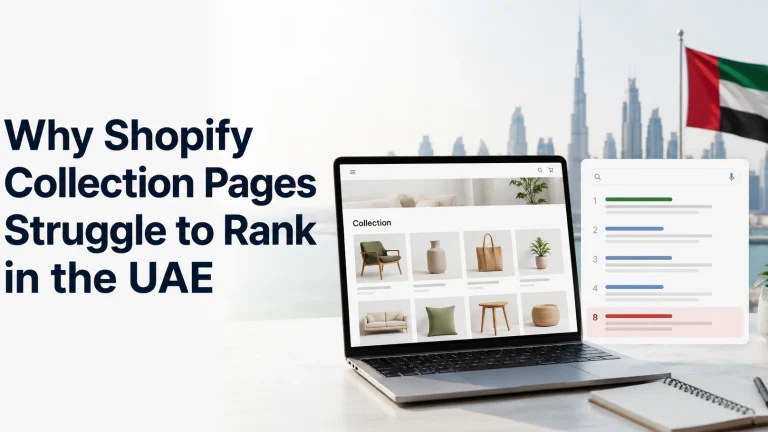
Shopify collection pages often struggle to rank because they target unclear keywords, contain limited content or generate similar URLs. A strong Shopify SEO strategy must address weak internal links, incorrect canonicals and hidden pagination.
For UAE stores, effective ecommerce SEO also requires local relevance. The collection should reflect how customers search, compare products, view AED prices and evaluate delivery or payment options.
Quick answer: If a collection is not ranking, check its search intent, content, filter URLs, canonical, indexability, pagination and internal links before adding more keywords.
Why collection pages matter for Shopify SEO
A collection page brings related products together, such as women’s running shoes, modest dresses, office chairs or gifts under AED 200.
These pages target broader commercial searches. A product page may rank for one shoe model, while a collection can target “running shoes UAE.”
Collection-page improvements are more effective when supported by a broader Shopify SEO strategy.
1. The collection targets an unclear keyword
Names such as “Our Products,” “Featured Items” and “Latest Collection” may work as promotional labels, but they do not clearly describe the category.
Use specific names that match customer language. “Women’s Sports Shoes” is clearer than “Women’s Collection,” while “Natural Skincare Products” explains more than “Beauty Favourites.”
Do not add location words automatically. Use “Dubai” or “UAE” only when the page genuinely serves that market and the phrase reflects real search intent.
2. The page contains little useful information
Many Shopify collection pages contain only an H1, filters and a product grid. This provides limited context about the products, audience and purpose of the page.
A short introduction can explain what the collection includes, who it suits and which options are available. It may also clarify UAE delivery or returns.
Additional buying advice can appear below the products so mobile shoppers reach the product grid quickly.
3. Product and collection pages compete
Keyword cannibalization can happen when several pages target the same search without serving different purposes.
For example, a running-shoe collection and an individual product should not both target “best running shoes UAE.” Use the collection for category searches and the product page for its model, name, size or defining feature.
If products are missing from search results, review these common Shopify product-page indexing problems.
4. Filter URLs create duplicate pages
Shopify filters help customers narrow products by size, colour, price, brand and availability. However, they can create many URL variations showing almost the same products.
Imagine a UAE footwear store with URLs for black shoes, black leather shoes and the same products sorted by price. Unless each serves a separate search need, they may compete with the main collection.
A collection such as “black office chairs in Dubai” may deserve a landing page when customers search for it. A URL created only by changing product order usually does not.
Review filters individually instead of blocking everything. Preserve valuable landing pages while controlling unnecessary combinations through an appropriate crawling, indexing and canonical strategy.
5. Canonical signals point to the wrong URL
A canonical identifies the preferred version of duplicate URLs. Problems appear when a collection points elsewhere, similar versions conflict or the preferred URL redirects.
Internal links should also lead directly to the canonical version. Otherwise, the store sends mixed signals about which page should appear in search.
Use Search Console’s URL Inspection tool to compare the declared and Google-selected canonicals. Only canonicalize genuinely equivalent pages.
Conflicting signals are a common Shopify technical SEO problem.
6. The collection is not indexable
A useful collection cannot rank if search engines cannot index it. An accidental noindex directive, incorrect status code, blocked resource or redirect can prevent discovery.
The preferred URL should return a successful response, remain indexable and appear in the sitemap and internal-link structure.
After making changes, inspect the live URL in Search Console. Confirm that Google can access the page and render its main content.
7. Important collections lack internal links
A collection may be indexable but still appear unimportant if few pages link to it.
Link priority collections from relevant navigation menus, breadcrumbs, homepage sections, product pages and buying guides. Use meaningful anchor text like “women’s running shoes” instead of generic phrases such as “click here”.
Avoid placing every collection in the main menu. A logical hierarchy should guide customers from broad departments to narrower categories.
8. Pagination hides products
Large collections commonly use pagination, infinite scrolling or a “load more” button. These features may work for customers while hiding products from search engines.
This happens when more products appear only after a user action and no standard link leads to the next group. Each paginated section should have a discoverable URL and crawlable link.
Test the collection on mobile and confirm that products beyond the first visible group can still be reached without relying only on JavaScript interactions.
9. The theme affects speed and usability
A slow theme can make collections frustrating to use. Large images, unnecessary scripts and filtering apps may delay the product grid on mobile.
Performance is not the only reason a collection ranks, but a better mobile experience can help visitors browse, compare and continue towards a purchase.
If the theme limits content, filtering or mobile usability, Shopify design and development services can address structural and performance problems, including Arabic RTL experiences.
10. The page is not adapted to UAE customers
A collection does not become locally relevant simply because “UAE” appears in its title.
Useful information may include AED pricing, delivery areas, returns, locally available sizes, cash-on-delivery options and Arabic content.
Arabic collection pages should be properly translated and easy to navigate. Avoid mixed-language pages or automated copies that do not help customers.
How to improve Shopify collection-page rankings
Start with collections that have the highest commercial value instead of changing every page at once.
For each priority collection:
- Select one clear category-level search intent.
- Improve the H1, title and meta description.
- Add a short, useful introduction.
- Check its canonical and indexing status.
- Review filter URLs and duplicate variations.
- Confirm that pagination uses crawlable links.
- Add links from related products, blogs and categories.
- Improve mobile usability and loading performance.
- Add useful UAE shopping information.
- Monitor impressions, queries and clicks in Search Console.
Businesses that need keyword planning, technical audits and collection optimization can use Shopify SEO services to identify and prioritize valuable improvements.
Making collection pages suitable for AEO and AI search
AEO and GEO do not require separate pages written for machines. Collection pages still need to be crawlable, indexable, accurate and useful.
Use descriptive headings and direct answers to buying questions. Accurate product information and breadcrumb structured data provide context. No special AI schema guarantees inclusion in AI-generated results.
Conclusion
Shopify collection pages rarely struggle because of one missing keyword. The problem usually involves unclear intent, thin content, duplicate filter URLs, weak internal links or conflicting technical signals.
Correcting these areas helps search engines understand the page while giving UAE customers a faster and clearer shopping journey.
Businesses that need regular help with theme issues, collection management and performance monitoring can work with Experts in Shopify through its Shopify support and training services.
1.How long does a Shopify collection page take to rank?
There is no fixed timeline because Google must recrawl the page, process the changes and compare it with competing results.
2. Should seasonal Shopify collections use a new URL every year?
Reuse the same URL when the collection serves the same search intent, and update its products, content and metadata.
3. What should happen when every product in a collection is out of stock?
Keep the page live if products will return soon, or redirect it to a closely related collection if it is permanently discontinued.
4. Does changing a Shopify collection URL affect SEO?
Changing the URL can temporarily affect visibility, so implement a permanent redirect and update its internal links, canonical and sitemap entry.
5. Do Shopify collection pages need backlinks to rank?
Backlinks are not mandatory, but relevant and authoritative links can improve a collection page’s credibility and ranking potential.