
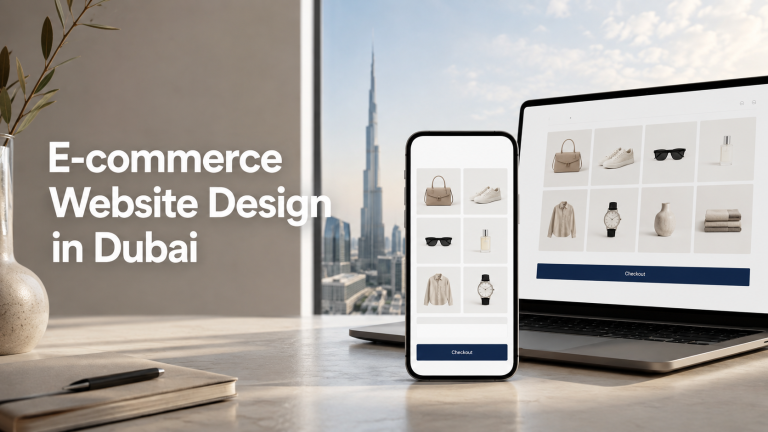
Ecommerce website design in Dubai works differently from Europe or the US. UAE shoppers respond to simple, mobile-first layouts with 2–3-click checkouts; cash on delivery alongside Apple Pay; a properly localised Arabic version; bundle pricing; and a WhatsApp channel to ask questions before they commit. In this market, fast beats fancy almost every time.
We are an official Shopify Partner based in the UAE and have built and rebuilt stores here for established regional brands and first-year startups alike. The pattern is remarkably consistent across both. The stores that convert are rarely the most visually ambitious ones; they’re the ones that remove the friction that local shoppers won’t tolerate.
That runs against much of the advice written about this market. The assumption is that a luxury city wants luxury websites: full-screen video, parallax scrolling, a hidden hamburger menu, and a lifestyle-first homepage. We have rebuilt enough UAE stores to say plainly that this is often the thing costing them sales.
Here are the ten design decisions that make the difference, in roughly the order they matter.
Key Takeaways
- Simplicity converts. UAE shoppers, particularly the local Arab community, consistently prefer clean, direct layouts over elaborate ones.
- Checkout should take 2–3 clicks. Every additional step can cost you orders.
- 85–90% of your traffic will be mobile. Design for mobile first, with the phone experience as the top priority.
- COD and Apple Pay are not optional. Which one you lead with depends on your price point.
- Arabic is where the real sales are. A properly localised Arabic store is a revenue decision, not a courtesy.
- WhatsApp is a sales channel here, not just a support ticket queue.
1. Simple Beats Sophisticated — and Checkout Should Take 2–3 Clicks
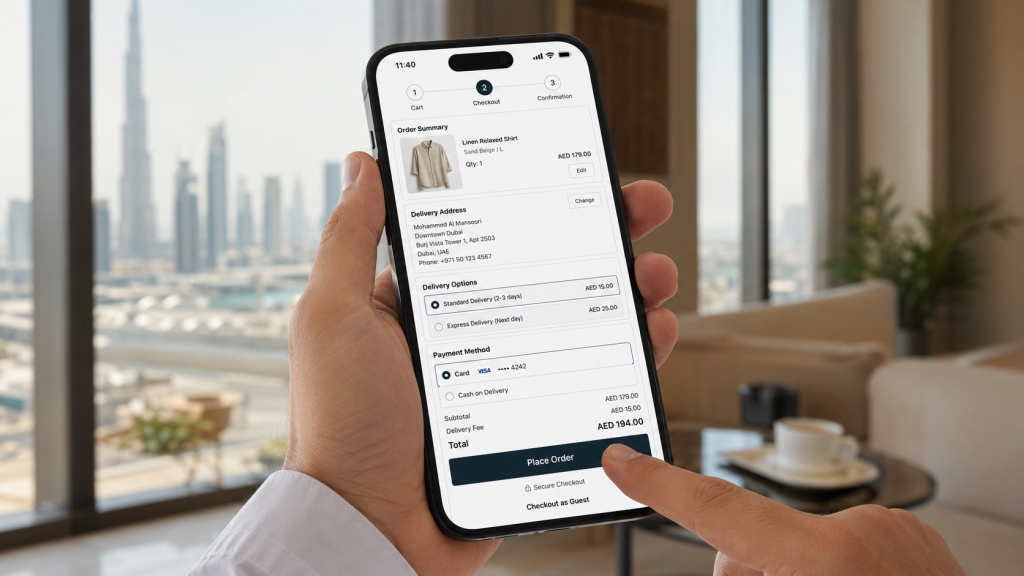
UAE shoppers prefer straightforward design. This is one of the most consistent things we see across the clients we work with, and it holds especially strongly for the local Arab community.
When brands come to us wanting layered animations, parallax scrolling, and multi-step interactive product configurators, we usually end up building something much simpler, and the numbers improve. The shopper here is decisive. They know roughly what they want, they want to see it clearly, and they want to buy it without a tour.
Practically, that means:
- A homepage that shows products above the fold, not a full-screen hero video
- Visible category navigation, not hidden behind a hamburger menu on desktop
- Product cards with an image, price, and add-to-cart action — nothing else competing for attention
- A checkout that takes 2 or 3 clicks from the product page to order confirmation
That last point deserves emphasis. Every additional field, extra page, or “create an account to continue” gate can lose you a percentage of buyers. On Shopify, this means enabling accelerated checkout properly, allowing guest checkout by default, and cutting the checkout form down to what you genuinely need to deliver the parcel.
This applies just as much to a well-known regional brand as it does to a startup selling its first product. We have not found a segment in this market that rewards a complicated checkout.
2. Mobile-First Is the Entire Brief, Not Just a Principle
Between 85% and 90% of your UAE traffic will come from mobile devices. Once you internalise that number, a lot of design arguments resolve themselves.
Mobile-first here doesn’t mean simply being responsive. It means the phone layout is the design and the desktop version is the adaptation. In practice:
- Build for fast loading before you build for visual impact. A store that loads in 1.8 seconds and looks plain can outperform a store that loads in 5 seconds and looks stunning.
- Test every tap target with a thumb, not a cursor.
- Keep the add-to-cart button sticky and visible while scrolling the product page.
- Compress and lazy-load imagery aggressively. Heavy hero images are one of the most common causes of slow UAE stores we audit.
- Check performance on a mid-range Android over a mobile network, not just on office Wi-Fi with an iPhone.
If a design choice makes the site heavier without making it clearer, it may be costing you money.
3. COD and Apple Pay: Your Payment Mix Is a Design Decision
Cash on delivery and Apple Pay are both important in the UAE; which one you lead with depends on your price point.
The rule we apply with clients:
| If you sell… | Prioritise | Why |
|---|---|---|
| Premium or high-ticket items to upper-income customers | Apple Pay (plus card and BNPL) | This audience is card-first and expects one-tap checkout. A missing Apple Pay button can be a visible gap. |
| Low-cost or impulse products | Cash on Delivery | Some customers will simply not prepay an unfamiliar store. Without COD, you may lose orders. |
| A mixed catalogue | Both, with equal visual weight | Don’t bury either one in a dropdown at the final step. |
The design implication is that these methods need to appear as recognisable buttons. Apple Pay, in particular, should show as an accelerated checkout option on the product page and cart, not only at the payment step.
COD comes with a well-known cost: returns. If you’re enabling it, read our guide on how to reduce COD returns in UAE e-commerce before you launch. The design and operational decisions that cut return rates are far easier to build in from the start than to retrofit.
4. Add a COD Checkout App So People Can Buy From the Product Page
For low-cost consumer products, letting customers place a COD order directly from the product detail page can remove a major drop-off point in the funnel.
The standard flow — product page, cart, checkout, address, confirm — is four screens. A COD form embedded on the product page can turn that into one. For impulse-priced items in this market, that difference can be substantial.
Several Shopify apps handle this well. The design decisions that matter include:
- Keep the form with the name, phone number, and address. Nothing else.
- Make the phone field primary — it’s how you’ll confirm the order.
- Show the total, including any COD fee, before the customer submits.
- Keep it visible without scrolling on mobile, directly under the price.
This is worth implementing for lower-priced products. Above a certain price point, buyers tend to want the reassurance of a full checkout, so test rather than applying it across the entire catalogue.
5. Confirm Every Order by SMS or WhatsApp Before You Ship
Order confirmation before dispatch is one of the highest-return operational steps in UAE e-commerce, and it starts at the design stage.
Especially with COD, a meaningful share of orders may be placed impulsively, contain a wrong digit in the phone number, or come from someone who changes their mind an hour later. Shipping those orders costs you the delivery fee, return fee, and handling time.
Confirming by SMS or WhatsApp before the parcel leaves your warehouse can catch many of these issues. To make it work, your design needs to:
- Capture a valid mobile number with proper UAE format validation at checkout
- Set the expectation on the thank-you page — tell the customer you’ll message shortly to confirm
- Make the confirmation a single yes/no reply, not a form
Build this into your order flow from day one rather than adding it after your first month of return costs.
6. Arabic Is Where the Real Sales Are
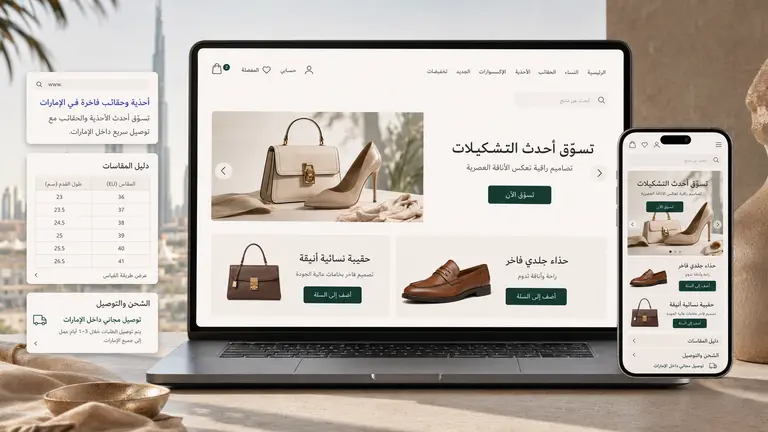
If you want serious revenue in this market, you need a properly optimised Arabic version of your store.
Not a translation plugin bolted on. A real Arabic experience: a right-to-left layout that actually works, product titles and descriptions written in Arabic rather than machine-translated, Arabic size guides and shipping information, and Arabic meta titles and descriptions so the pages can rank in Arabic search.
This is where many stores in the UAE cut corners, which is exactly why the ones that do it properly can face less competition. A machine-translated store with broken RTL can perform worse than no Arabic version at all because it signals carelessness to precisely the audience you’re trying to win.
RTL design specifics worth getting right:
- Icons, arrows, and progress indicators must mirror — a “next” arrow pointing right is wrong in Arabic.
- Your theme needs genuine RTL support, not just a CSS override.
- Arabic typography needs its own line-height and font-size treatment; Latin settings can look cramped.
- Test the checkout in Arabic. It is one of the most commonly broken parts.
7. Design the Product Page to Be Understood Without Reading
Your product detail page should communicate the product visually, with comparison information, before anyone reads a paragraph.
The best-performing PDPs we build in this market are heavily pictorial. Instead of relying on a long specification list, they use:
- Image blocks showing dimensions, materials, and features directly on the photo
- Side-by-side comparison visuals when you sell multiple variants or models
- Real usage photos, not only studio shots
- A short, scannable feature grid with icons — not a wall of text
- Size and fit guides as images, not tables of numbers
Part of why this works well here is language. Your customers include Arabic speakers, English speakers, and a large multilingual expatriate population. A product image that explains itself works for all of them. Three paragraphs of English work for only a subset.
Navigation on the PDP matters too: keep the gallery swipeable, place the variant selector immediately under the price, and keep the add-to-cart button within easy reach.
8. Build Bundle Pricing Into the Design
“Buy 1 for AED X, Buy 2 for AED Y” offers can perform exceptionally well across the region.
This doesn’t have to be a promotion that you run occasionally. For many categories, it can be a permanent part of the offer, and it belongs on the product page rather than only in a banner.
What works:
- A tiered selector on the PDP showing 1, 2, and 3-unit pricing with the saving on each
- The middle or highest-value option visually pre-selected
- Per-unit pricing shown alongside the total so the value is obvious at a glance
- Clear labelling of the most popular tier
We often see this lift average order value more than many other individual PDP elements in this market. If your theme doesn’t support tiered bundle display natively, a custom implementation may be worth considering.
9. WhatsApp Chat Isn’t Supported — It’s Your Sales Floor
This is a genuine difference from some Western e-commerce markets, where live chat is mostly a post-purchase support channel. Here, conversation can be part of the buying process. Customers may ask about sizing, delivery timing, whether the colour matches the photo, or whether you can offer a better price.
Design implications:
- A persistent WhatsApp button on mobile, positioned so it doesn’t cover the add-to-cart button
- Pre-filled messages including the product name and URL so the conversation starts with context
- Response-time expectations set honestly — an unanswered WhatsApp message can be worse than having no chat option
- If volume justifies it, a WhatsApp agent or AI assistant handling common questions and escalating the rest
Staff that channels with salespeople, not only ticket handlers. A well-managed WhatsApp conversation can be an important part of the buying journey.
10. Bespoke Design Is Worth It Once You’re Mid-Market or Larger
For mid-sized and large brands, a bespoke Shopify build can pay for itself. For early-stage stores, a well-configured premium theme may not need replacing yet.
The honest threshold is this: if your store is doing meaningful monthly revenue, has a real brand identity to protect, or needs functionality that your theme struggles with – bundle logic, B2B pricing tiers, complex variant structures, or genuine RTL – you may have outgrown the theme.
Every workaround stacked on top of an unsuitable theme can slow the site down and make future changes harder.
At that stage, hiring a Shopify Partner based in the region can be valuable. Not simply for proximity, but because a partner working in this market may already understand COD apps, local payment gateways, Arabic RTL requirements, and regional courier integrations.
You can see how we approach this in our Shopify design and build service and read more about our wider approach to e-commerce website development in Dubai.
Frequently Asked Questions
1. How much does ecommerce website design cost in Dubai?
It varies widely by scope. A well-configured premium theme with proper UAE payment setup, Arabic support, and COD integration sits at the lower end. A fully bespoke Shopify build with custom bundle logic, B2B functionality, and complete RTL localisation costs considerably more. The main cost drivers are depth of Arabic localisation, custom app development, and how much of your catalogue needs restructuring.
2. Do I need an Arabic version of my ecommerce website in the UAE?
If you want to reach the full market, yes. English-only stores can perform reasonably with the expatriate audience, but a properly localised Arabic store — with real translation, a working RTL layout, and Arabic SEO — reaches an audience most competitors are ignoring.
3. Should I offer Cash on Delivery on my UAE store?
If you sell lower-priced consumer products, yes, a significant share of that segment will not pre-pay. If you sell premium items to an upper-income audience, Apple Pay and cards matter more, though offering COD alongside rarely hurts. Plan for return management before you enable it.
4. What percentage of UAE ecommerce traffic is mobile?
For most stores we work with, mobile accounts for 85–90% of sessions. Design and performance decisions should be made for that device first.
5. Is Shopify a good platform for an ecommerce website in Dubai?
For most UAE retail businesses, yes. It handles multi-currency, has strong local payment gateway and COD app support, integrates with regional couriers, and supports Arabic RTL with the right theme. Larger operations with complex B2B or ERP requirements should evaluate Shopify Plus specifically.
6. How long does it take to build an ecommerce website in Dubai?
A theme-based store with proper UAE configuration typically takes a few weeks. A bespoke build with custom functionality and full Arabic localisation takes considerably longer, with localisation and custom feature work usually driving the timeline more than the visual design.
Getting the design decisions right from the start
Most of the stores we’re asked to rescue in this market don’t have a design problem in the aesthetic sense. They have a store designed for a shopper who doesn’t exist here, one who will happily complete a five-step checkout, pay by card, read English product descriptions and never think to send a WhatsApp message.
Design for the shopper you actually have: on a phone, deciding quickly, wanting COD or Apple Pay, possibly reading in Arabic, and likely wanting to ask you something first. Everything on this list follows from that.
If you’re planning a new build, or you suspect your current store is losing orders to friction, get in touch. We’re an official Shopify Partner in the UAE and we’ll tell you honestly whether you need a rebuild or just a set of fixes.
Contact MAQ Computer Services LLC.
Official Shopify Partner — UAE
Phone: +971 55 494 3599 | +971 50 708 0116
Email: info@maquae.com


