
Managing inventory has become one of the biggest challenges for modern e-commerce businesses, especially in the fast-growing UAE e-commerce market. How to Integrate AI Automation with Shopify for Inventory Management is now a common question among Shopify store owners looking to improve operational efficiency, reduce stock issues, and automate repetitive tasks. From stock shortages and overstocking to inaccurate demand forecasting, manual inventory management processes can slow business growth and reduce profitability.
That’s why many businesses in the UAE are now learning how to integrate AI automation with Shopify for inventory management in 2026. AI-powered systems help Shopify stores automate stock tracking, forecast demand, minimize operational costs, and improve customer satisfaction through smarter inventory control. As competition increases across Dubai, Abu Dhabi, and other UAE markets, AI-driven inventory automation is becoming essential for scalable e-commerce growth.
In this guide, Maq Computer Services LLC explains how AI inventory management works, why it matters for modern e-commerce businesses in the UAE, and how Shopify store owners can successfully implement automation solutions for long-term growth.
Why AI Automation Matters for Shopify Inventory Management
Traditional inventory management relies on manual processes, spreadsheets, and guesswork. This approach leads to costly mistakes, wasted time, and missed sales opportunities.
AI for inventory management changes the game entirely by:
- Analyzing historical sales data, seasonal trends, and market conditions using machine learning algorithms.
- Predicting demand with remarkable accuracy.
- Ensuring you always have the right products in stock at the right time.
- Providing the speed and precision needed to stay competitive in markets like Dubai and the UAE.
- Meeting high customer expectations for instant availability, fast shipping, and seamless experiences.
All of these capabilities are essential for effective e-commerce inventory management in today’s competitive landscape.
Understanding AI-Powered Inventory Management
AI-powered inventory management uses machine learning, predictive analytics, and automation to optimize how you track, order, and manage stock. Unlike traditional systems that simply record inventory levels, AI systems learn from your data and make intelligent recommendations.
These systems can predict when you’ll run out of popular items, identify slow-moving products, optimize reorder points, and even automate purchase orders. The result is reduced carrying costs, fewer stockouts, and improved cash flow.
Key Benefits of Shopify AI Automation for Inventory
Accurate Demand Forecasting:
AI algorithms analyze dozens of factors—past sales, seasonality, marketing campaigns, competitor behaviour, and even weather patterns—to predict future demand. This level of accuracy is impossible to achieve manually.
Real-Time Inventory Tracking:
Shopify automation provides instant visibility across all sales channels. Whether customers buy from your online store, physical location, or marketplace, your inventory updates automatically.
Reduced Human Error:
Manual data entry leads to mistakes. Shopify automation tools eliminate these errors by automatically syncing inventory levels, processing orders, and updating stock counts.
Cost Optimization:
By maintaining optimal stock levels, you reduce storage costs and minimize capital tied up in excess inventory. AI helps you find the perfect balance between availability and efficiency.
How to Integrate AI Automation with Shopify: Step-by-Step Guide
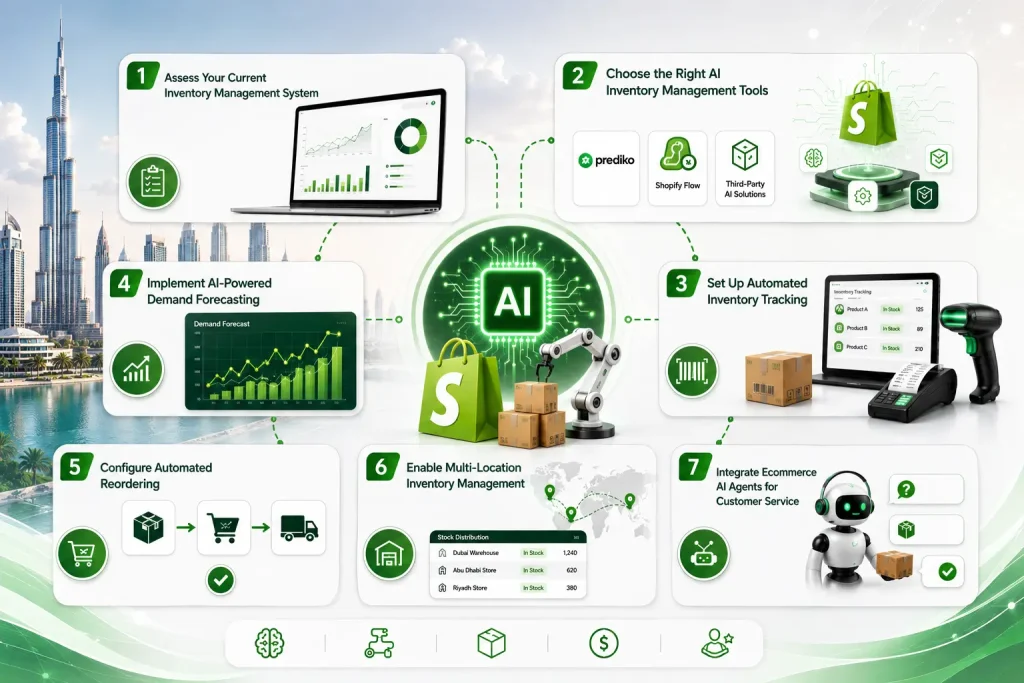
Step 1: Assess Your Current Inventory Management System
Start by evaluating your existing processes. Document pain points like frequent stockouts, excess inventory, or time spent on manual tasks. Identify which products have the most unpredictable demand patterns. These are prime candidates for AI-powered forecasting. Review your current Shopify inventory management setup. Understanding your baseline helps you measure improvement after implementing AI automation.
Step 2: Choose the Right AI Inventory Management Tools
Several powerful Shopify apps integrate seamlessly with Shopify to provide AI-driven inventory management:
- Prediko inventory management offers AI-powered demand forecasting, automated purchase orders, and multi-location tracking with advanced analytics. It’s particularly effective for growing businesses that need sophisticated forecasting.
- Shopify flow is Shopify’s native automation tool that lets you create custom workflows without coding. You can set up automated reorder triggers, low-stock alerts, and inventory transfers between locations.
- Third-party AI solutions like inventory optimization platforms can integrate via Shopify’s API to provide enterprise-grade forecasting and automation capabilities.
For businesses in Dubai seeking comprehensive e-commerce automation services, partnering with a Shopify automation agency like Maq Computer Services LLC ensures proper setup and ongoing optimization.
Step 3: Set Up Automated Inventory Tracking
Enable Shopify’s built-in inventory tracking for all products. This creates the data foundation that AI systems need to function effectively. Configure barcode scanning if you have physical inventory. This ensures accurate, real-time updates as products move through your warehouse or store. Integrate your point-of-sale system with Shopify so that in-store and online inventory sync automatically. This unified view is essential for accurate AI predictions.
Step 4: Implement AI-Powered Demand Forecasting
Connect your chosen AI inventory management tool to your Shopify store. Most apps require access to your sales history, product catalogue, and inventory data. Allow the system to analyze at least 3-6 months of historical data for accurate predictions. The more data available, the better the AI performs. Review the initial forecasts and adjust parameters based on your business knowledge. AI learns from your feedback and becomes more accurate over time.
Step 5: Configure Automated Reordering
Set reorder points for each product based on AI recommendations. These thresholds trigger automatic purchase orders when stock falls below optimal levels. Use Shopify Flow to create workflows that notify suppliers, generate purchase orders, or even place orders automatically through integrated systems. Establish safety stock levels for critical products. AI calculates these buffers based on lead times, demand variability, and service level targets.
Step 6: Enable Multi-Location Inventory Management
If you operate multiple warehouses or retail locations, configure Shopify’s multi-location inventory features. AI can then optimize stock distribution across all locations. Set up automated inventory transfers between locations based on demand patterns. This ensures popular items are always available where customers need them. Monitor location-specific performance metrics to identify opportunities for further optimization.
Step 7: Integrate E-commerce AI Agents for Customer Service
Modern Shopify marketing automation extends beyond inventory to customer interactions. E-commerce AI agents can handle order enquiries, provide real-time stock information, and process returns automatically. These AI agents access your inventory data to give customers accurate availability information 24/7. This reduces support tickets and improves customer satisfaction. Configure AI agents to escalate complex issues to human staff while handling routine inventory-related questions independently.
Best Practices for AI Inventory Management on Shopify
Start Small and Scale Gradually
Don’t try to automate everything at once. Begin with your highest-volume or most problematic products. Once you see results, expand AI automation to additional categories.
Maintain Data Quality
AI is only as good as the data it receives. Regularly audit your product information, ensure accurate categorization, and keep supplier lead times updated. Clean, structured data is the foundation of effective artificial intelligence inventory management.
Monitor and Adjust Regularly
Review AI recommendations weekly during the first month. Look for patterns where the system over- or under-predicts demand. Adjust parameters seasonally and after major marketing campaigns. AI learns from these adjustments and improves future predictions.
Combine AI Insights with Human Expertise
AI provides data-driven recommendations, but you understand your business context. Use AI as a powerful tool to inform decisions, not replace strategic thinking entirely.
Integrate Across Your Tech Stack
Connect your AI inventory system with accounting software, CRM platforms, and marketing tools. This creates a unified e-commerce automation ecosystem that maximizes efficiency.
Common Challenges and Solutions
Challenge: Insufficient Historical Data
Solution: If you’re a new store, start with industry benchmarks and competitor analysis. As you accumulate sales data, AI accuracy will improve rapidly.
Challenge: Seasonal Demand Fluctuations
Solution: AI excels at identifying seasonal patterns, but you may need to manually flag special events like Ramadan, Dubai Shopping Festival, or Black Friday for more accurate forecasting.
Challenge: Integration Complexity
Solution: Work with a Shopify automation agency in Dubai, like Maq Computer Services LLC, to handle technical integration and ensure all systems communicate properly.
Challenge: Staff Resistance to Automation
Solution: Emphasize that AI handles repetitive tasks, freeing your team for strategic work. Provide training and demonstrate quick wins to build confidence.
The Future of AI in E-commerce Inventory Management
The evolution of AI technology continues to accelerate. In 2026 and beyond, expect even more sophisticated capabilities:
- Hyper – personalisation will extend to inventory decisions, with AI predicting demand at the individual customer level for made-to-order models.
- Autonomous supply chains will use AI to negotiate with suppliers, optimise shipping routes, and handle procurement without human intervention.
- Predictive commerce will anticipate customer needs before they search, positioning inventory proactively based on behavioural signals.
- Blockchain integration will provide unprecedented supply chain transparency, with AI using this data for more accurate lead time predictions.
Businesses that embrace AI automation now will be positioned to leverage these emerging capabilities as they become available.
Measuring Success: Key Metrics to Track
After implementing AI automation for inventory management in Shopify, monitor these metrics:
- Inventory turnover ratio: Higher turnover indicates more efficient inventory management
- Stockout rate: Should decrease significantly with AI forecasting
- Carrying costs: Track reduction in storage and capital costs
- Order fulfillment time: Should improve with optimized stock placement
- Forecast accuracy: Measure how closely AI predictions match actual sales
- Manual task time: Quantify hours saved through automation
Set baseline measurements before implementation and track monthly progress. Most businesses see measurable improvements within 60-90 days.
Why Choose Maq Computer Services LLC for Shopify Automation
Implementing AI-powered inventory management requires technical expertise and strategic planning. Maq Computer Services LLC specializes in e-commerce automation services for businesses throughout the UAE.
As a leading Shopify automation Dubai provider, Maq Computer Services LLC offers end-to-end implementation, from initial assessment through ongoing optimization. Their team understands the unique challenges of the Middle Eastern market and can configure AI systems that account for regional shopping patterns, holidays, and consumer behaviours.
Whether you’re a small business taking your first steps toward automation or an established retailer seeking enterprise-grade AI solutions, Maq Computer Services LLC provides the expertise needed to maximize your investment.
Conclusion: Transform Your Inventory Management Today
Learning how to integrate AI automation with Shopify for inventory management isn’t just about adopting new technology—it’s about positioning your business for sustainable growth in an increasingly competitive market.
AI-powered inventory management reduces costs, improves customer satisfaction, and frees your team to focus on strategic initiatives rather than manual tasks. For e-commerce businesses in the UAE, where customer expectations are high and competition is fierce, these advantages can be decisive.
The technology is mature, accessible, and proven. The question isn’t whether to implement AI automation but how quickly you can get started. Ready to transform your Shopify inventory management with AI automation? Contact MAQ Computer Services LLC today for a consultation and discover how AI can optimize your inventory, reduce costs, and accelerate your e-commerce growth.
| Contact MAQ Computer Services LLC Official Shopify Partner — UAE Phone: +971 55 494 3599 | +971 50 708 0116 Email: info@expertsinshopify.com Visit the official website: MAQ Computer Services LLC |
FAQ
1. What is AI-powered inventory management for Shopify?
AI-powered inventory management uses machine learning algorithms to predict demand, automate reordering, and optimize stock levels across your Shopify store. Unlike traditional systems that simply track inventory, AI analyzes historical data, seasonal patterns, and market trends to make intelligent recommendations that reduce stockouts and excess inventory.
2. How much does it cost to implement AI inventory management on Shopify?
Costs vary based on your business size and needs. Basic Shopify automation tools like Shopify Flow are included with most Shopify plans at no extra cost. Dedicated AI inventory management apps typically range from $50 to $ 500 per month. Enterprise solutions and custom integrations through agencies like Maq Computer Services LLC are priced based on specific requirements.
3. Can small businesses benefit from AI inventory automation?
Absolutely. AI inventory management is no longer exclusive to large enterprises. Small and medium-sized businesses often see the most dramatic improvements because they’re moving from manual processes to intelligent automation. Even with limited historical data, AI systems can provide valuable insights and automation that save time and reduce costs.
4. How long does it take to see results from AI inventory management?
Most businesses notice improvements within 30-60 days of implementation. Initial setup typically takes 1-2 weeks, followed by a learning period where the AI analyses your data. Forecast accuracy improves continuously, with significant gains visible after the system has processed a full sales cycle (usually 3-6 months).
5. Does AI inventory management work for businesses with multiple locations?
Yes, AI excels at multi-location inventory optimization. Advanced systems can predict demand for each location independently, recommend optimal stock distribution, and automate transfers between locations. This is particularly valuable for businesses with both online and physical retail presences in the UAE.
6. Can AI inventory management integrate with my existing systems?
Modern AI inventory solutions are built to integrate with Shopify’s ecosystem and the most common business tools, including accounting software (QuickBooks, Xero), CRM platforms, shipping providers, and ERP systems. Maq Computer Services LLC specialises in creating seamless integrations that connect all your business systems.


