
Running a Shopify store in the UAE is not the same as running one in London or New York. If you rely on professional Shopify maintenance Dubai services, you know the work goes far beyond design updates. You are managing multi-currency pricing, including AED, integrating with local payment gateways like Telr and PayTabs, syncing inventory across Noon and Amazon UAE, and shipping through Aramex, JnT, and SkyEx. Each of these layers adds a place where something can break.
After maintaining 15+ active Shopify stores for UAE clients, M A Q Computer Services LLC has learned what monthly maintenance actually needs to cover. Not the generic “check your store” advice you read on most agency blogs. The real tasks that prevent the disasters that hit UAE stores every month.
A single app update. A new theme version. A payment gateway that pushes a configuration change over the weekend. These risks are particularly important to monitor after a Shopify store migration, when URLs, apps, payment settings, and integrations may have changed. Any one of these can quietly take your checkout offline, desync your stock, or send your customers to a broken page. By the time you notice, you may already have lost sales, and prolonged technical issues could eventually affect your search visibility.
This 2026 guide walks you through our 12-point monthly maintenance checklist, the UAE-specific checks most agencies miss, what maintenance actually costs in the UAE market, and how to know if your store is too small to justify a maintenance contract.
Why UAE Shopify Stores Need Monthly Maintenance in 2026
The cost of doing nothing has gone up. In 2024 and 2025, we saw three failure patterns repeat across multiple UAE stores:
The “free app” that killed a checkout. One UAE fashion brand installed a pop-up app to grow their email list. Within 48 hours, the conversion rate had dropped 30%. The pop-up was firing on the checkout page and blocking the “Place Order” button on mobile. Nobody noticed for two days. The fix took 10 minutes. The lost sales did not come back.
The payment gateway is a dead-end. Shopify Payments (Stripe) is integrated directly with Shopify Checkout, but in the UAE it is currently available through early access to selected merchants. Depending on the provider and integration method, third-party payment gateways such as Telr, PayTabs, Network International, and CCAvenue may process payments during checkout or redirect customers to a secure external payment page. They redirect customers to an external page. The payment redirect flow can sometimes experience issues, particularly after changes to the theme or checkout configuration. MAQ checks this monthly because we have seen AED 50,000+ in abandoned carts from a single broken redirect.
The courier API lost an order. A Dubai beauty brand was using JnT to ship across the UAE. After a Shopify API version bump, the JnT integration silently stopped sending tracking numbers back to Shopify. Customers got their orders, but the brand thought 40% of orders had been lost. They nearly shut down the store. These are not edge cases. They are the cost of running a multi-channel, multi-gateway, multi-courier UAE store without someone watching the integration layer. That is what ongoing Shopify support is for.
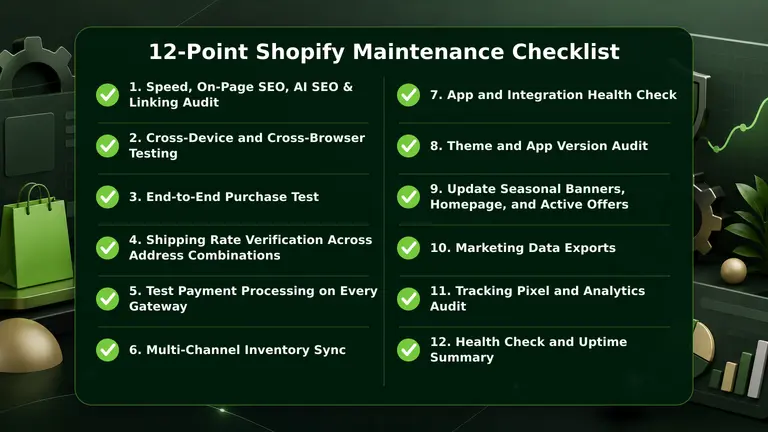
The 12-Point Monthly Maintenance Checklist
Our team follows this checklist each month when maintaining our clients’ Shopify stores. We do not publish a prettier version. This is it.
1. Speed, On-Page SEO, AI SEO & Linking Audit
The single most important task on the list. It is also the one that covers the most ground.
- Page speed. Run a Core Web Vitals check in Google Search Console and PageSpeed Insights. We track LCP (Largest Contentful Paint), CLS (Cumulative Layout Shift), and INP (Interaction to Next Paint). Anything over the “Good” threshold gets a ticket.
- On-page SEO. Audit every key page (home, top 20 PDPs, top 10 collections) for missing or duplicate meta titles, H1 hierarchy issues, alt text on images, and keyword cannibalisation. This is the lowest-hanging fruit in UAE searches because most stores are not doing it.
- AI SEO. This is the 2026 differentiator. We test eligible products and FAQ schema using Google’s Rich Results Test and validate HowTo and organisation markup with Schema Markup Validator. We check that the FAQ block on category pages is fresh and actually answers real questions UAE shoppers ask. We monitor where and how your brand is mentioned online. ChatGPT, Perplexity, and AI Overviews cite pages that have clean, structured data and a clear Q&A structure. Most UAE stores have neither.
- Internal linking. Audit hub-and-spoke health, identify orphan pages, fix broken internal anchors, and verify breadcrumb schema. A clean internal link graph helps both Google and AI engines understand what your store is about.
- External linking. Quick backlink profile check, broken outbound link audit, and authority citation opportunities. The backlinks to your money pages should be from trusted UAE and regional sources.
Tools: Google Search Console, Google Analytics 4, Microsoft Clarity, PageSpeed Insights, Screaming Frog (for technical crawls).
2. Cross-Device and Cross-Browser Testing
We test the buyer journey on the three device classes (desktop, tablet, mobile) and across the three browsers that matter for UAE shoppers (Chrome, Safari, Firefox). On every combination, we verify:
- Home page renders correctly.
- Product detail pages load correctly and display the right images and pricing.
- Collection pages filter and sort properly.
- Cart works end-to-end.
- Checkout works end-to-end.
This is the “manual” part of the audit. We have seen stores work perfectly on Safari for iPhone while a layout issue hides the “Buy Now” button on Chrome for Android. A 5-minute check saves a 5-figure month.
3. End-to-End Purchase Test
This is different from Task 2. Task 2 checks that pages render. Task 3 checks that the full purchase actually completes. We place a real test order with a real (small) product and run it through the following:
- Add to cart
- Apply discount code
- Enter shipping address (UAE + GCC + international, depending on the store)
- Select shipping method
- Hit checkout
- Pay through every active gateway
- Receive the order confirmation email
- See the order in Shopify admin
- See the order in the ERP (if integrated)
This is the only way to catch gateway-specific issues, discount code conflicts, and shipping rate miscalculations.
4. Shipping Rate Verification Across Address Combinations
UAE stores often have complex shipping logic: free shipping over AED 200, different rates for the UAE vs Saudi vs Kuwait, COD surcharges, and same-day delivery in Dubai only. After every app update or theme change, the shipping calculator can drift.
We test a matrix of:
- Dubai, Abu Dhabi, Sharjah (urban UAE)
- Ras Al Khaimah, Fujairah (remote UAE)
- Riyadh, Jeddah, Dammam (KSA)
- Kuwait City, Doha, Manama (other GCC)
- International (sample: UK, US, India)
For each, we check the rate, the ETA, and whether the order can actually be completed.
5. Test Payment Processing on Every Gateway
We test every gateway the store uses. This is where we catch the broken redirects that quietly kill conversion. Specifically:
- Stripe / Shopify Payments. Confirm the native flow works.
- Telr. Confirm the redirect completes, and the order is marked paid.
- PayTabs. Same.
- Network International. Same.
- CCAvenue. Same. CCAvenue and Amazon Pay are the gateways that most often have broken redirect URLs after a theme update. They are external to Shopify, so a theme change can break them silently.
- Apple Pay / Google Pay. Test the wallet flow on a real device.
- COD. Test that COD is still selectable, that the COD surcharge (if any) is applied correctly, and that the order flows through the courier system with the right payment method flag.
Any broken gateway gets fixed before we sign off the maintenance month.
6. Multi-Channel Inventory Sync
UAE brands typically sell on Shopify Plus, at least one of Noon, Amazon UAE, Mumzworld, and Ounass, and sometimes their own POS. Inventory has to stay in sync across all of them, or you sell items you do not have.
We verify:
- Shopify stock levels match the connected channels
- Low-stock alerts are firing correctly
- Out-of-stock products are unpublished across all channels within 1 hour
- New product launches are published to all channels
- ERP sync (if any) is up to date
This is a daily task for active stores. On a monthly maintenance cycle, we do a full audit to catch drift that builds up over time.
7. App and Integration Health Check
Most Shopify stores run 15-30 apps. On top of that, each store connects to at least one external system—ERP, courier, payment gateway, or marketing tool. Every one of those connections is a place that can break.
We review the installed app list, remove anything unused, and verify every active integration:
- Shopify Flow automations are firing as expected
- Courier APIs (Aramex, JnT, SkyEx, iMile, etc.) are returning valid responses and writing tracking numbers back to Shopify
- ERP connections (SAP, Oracle, Zoho, etc.) are syncing both ways
- Marketing tools (Klaviyo, Mailchimp, HubSpot) are still receiving events
- Review apps (Loox, Judge.me, Yotpo) are pulling and displaying
- Analytics integrations (GA4, Meta Pixel, Google Ads tag) are firing on every page
This task catches the silent failures that the merchant never sees. A tracking pixel that stopped firing last month means last month’s ad spend was attributed to nothing.
8. Theme and App Version Audit
Shopify pushes theme and app updates constantly. Most merchants auto-update. Some updates break things.
We check:
- Current theme version vs latest available
- Current app versions vs latest available
- Any apps flagged as deprecated or unsupported
- Any apps that have changed pricing unexpectedly
- Any breaking changes in the changelogs that affect this specific store
For Shopify Plus stores, perform the MAQ test on a duplicate theme before pushing any update to production. For advanced stores, we use staging where possible and schedule updates for low-traffic windows.
9. Update Seasonal Banners, Homepage, and Active Offers
The store should not look the same in July as it did in March. Every month, we update:
- Homepage hero banners (seasonal, campaign, or offer)
- Featured collections
- Active promo codes
- Announcement bar
- Sticky add-on offers
- Free-shipping threshold messaging
- Holiday-specific copy (Ramadan, Eid, UAE National Day, DSS, White Friday, Back to School)
This is also when we check that the right offers are running and that expired offers have been removed.
10. Marketing Data Exports
The marketing team (in-house, agency, or founder) needs fresh data every month. We export on request and on schedule:
- Sales by channel (Shopify vs Noon vs Amazon)
- Sales by product category
- Top 50 SKUs by revenue and by margin
- Customer cohort report (new vs returning)
- AOV, conversion rate, abandoned cart rate
- Coupon code performance
- Customer support ticket themes
This is a half-day task on average, depending on the store’s data complexity. We deliver it as a Google Sheet linked in the monthly maintenance report. These insights can also guide your Shopify marketing strategy by showing which products, channels, and campaigns perform best.
11. Tracking Pixel and Analytics Audit
Most UAE stores run Meta Ads, Google Ads, and TikTok Ads. The pixels for all three need to fire correctly on every page, especially on checkout completion. When they do not, the ad platform’s learning phase breaks, CPM goes up, and the merchant wonders why their ads “stopped working”.
Every month we verify in-browser DevTools and the platform diagnostics:
- Meta Pixel firing on every page (PageView, ViewContent, AddToCart, InitiateCheckout, Purchase)
- Google Ads conversion tag firing on Purchase
- TikTok Pixel firing on key events
- GA4 events configured (purchase, add_to_cart, view_item, begin_checkout)
- Enhanced Conversions enabled for Google Ads
- Facebook Conversions API (CAPI) sending server-side events
Any pixel not firing gets fixed before the maintenance month closes.
12. Health Check and Uptime Summary
The final task. A summary of:
- Uptime over the month (target: 99.9%)
- Any outages and root cause
- All incidents from the month (gateway down, app conflict, theme bug)
- All fixes applied
- Open issues for next month
- Recommendations for the store owner
This is delivered as a written report. The owner sees what happened, what was fixed, and what is on the roadmap. No surprises.
UAE-Specific Maintenance Items Most Agencies Miss
Generic “Shopify maintenance checklist” content from US or UK agencies misses the things that actually break UAE stores. Here is what we check that you will not find on most lists:
Payment Gateway Failover Planning
When Telr goes down (and it does, several times a year), your store has to keep taking orders. We verify that your fallback gateway is configured and tested, that your checkout shows a clear status if a gateway is degraded, and that your support team knows how to switch manually if needed.
Arabic RTL on Checkout
If your store has an Arabic version, the checkout needs to render correctly in right-to-left. Most UAE stores launch with English only, then add Arabic six months later, and the checkout breaks in subtle ways (button placement, form alignment, currency display). We audit this on every maintenance cycle.
AED Currency and Price Display
MAQ have seen UAE stores with prices showing in USD because the theme was set to USD by default. We verify every price tag, every checkout total, and every confirmation email is in AED with the right formatting (AED 199.00, not “AED199” or “Dhs199”).
VAT-Inclusive Display
UAE VAT is 5%. PDPs and checkout must show VAT-inclusive prices, not “plus VAT. ” We verify the tax settings in Shopify, the display in the cart, and the wording on receipts.
Free Shipping Threshold
Common UAE threshold: free shipping over AED 100, 200, or 500. After every shipping zone change, we verify the threshold is still applied correctly, and the messaging on the cart and checkout reflects it.
Local Courier API Status
Aramex, JnT, SkyEx, and iMile all have APIs that occasionally go down. We monitor the integration status daily and switch to a backup courier if the primary one is degraded.
Ramadan and Sale Season Preparation
In the two weeks before Ramadan, White Friday, DSS, and UAE National Day, we add an extra layer of preparation: load testing, payment gateway warm-up, server capacity confirmation, campaign timing aligned with Iftar, and pre-scheduled offer launches.
Trade Licence and Gateway Renewal Reminders
UAE business trade licences are renewed annually. Payment gateways like Network International require a current trade license. We send a reminder 60 days before the store’s trade licence renewal because a lapsed license can take a payment gateway offline within 24 hours.
What Does Shopify Maintenance Cost in the UAE?
Honestly, it depends on the Shopify store. The cheap end of the market is flooded with freelancers offering “maintenance” for AED 500-1,000 a month. They typically log 2-3 hours, run a speed test, and call it done. That is not maintenance; that is a checkbox.
M A Q Computer Services LLC’s monthly maintenance packages run from AED 2,000 per month for small stores up to AED 8,000 per month for high-traffic UAE brands. The price depends on the following:
- Number of products and SKUs
- Number of sales channels (Shopify + Noon + Amazon)
- Number of payment gateways in use
- Number of courier integrations
- Number of hours of marketing data work requested
- Whether the store is on Advanced or Plus Shopify
A typical UAE store doing AED 50,000-200,000 in monthly sales falls in the AED 2,500-4,000 per month range. Stores doing AED 500,000-5,000,000 a month usually run AED 5,000-8,000 per month.
Maintenance is a fraction of what one outage costs. We have seen a single broken payment gateway redirect cost a UAE store AED 50,000 in a weekend. The math is simple.
When You Don’t Need a Monthly Maintenance Contract
Not every store needs a retainer. Our honest advice:
- Below AED 30,000 in monthly sales: You do not need a maintenance package. A one-off quarterly health check at AED 1,500-2,000 is enough. We offer these.
- AED 30,000-50,000 in monthly sales: You are in the grey zone. A Shopify monthly support package (AED 2,000/mo) makes sense if you sell on multiple channels or run paid ads.
- AED 50,000+ in monthly sales: A maintenance package is non-negotiable. The cost of one outage exceeds the annual cost of the package.
- Multiple sales channels (Shopify + Noon + Amazon + POS): A maintenance package is non-negotiable regardless of sales volume. The integration surface is too large to manage reactively.
If your Shopify store is below the threshold and you are not ready for a maintenance package, MAQ’s free monthly health check email is the next best thing.
How MAQ Computer Services LLC Runs Maintenance for 15+ UAE Stores
We have been maintaining UAE Shopify stores since 2014. Today, our team supports 15 active maintenance clients across fashion, beauty, F&B, electronics, and luxury.
The way we work:
- One dedicated maintenance lead per store. You will not work with a rotating freelancer. You will always know who is managing your account.
- Monthly written report. Every maintenance month closes with a written report. The store owner sees exactly what was done, what was found, and what is recommended.
- Defined response times. Critical issues (gateway down, checkout broken) are responded to within 2 hours during UAE business hours. Non-critical issues are addressed in the next maintenance cycle.
- Tools that match the job. We use Microsoft Clarity for session replay, Google Search Console for SEO, Google Analytics 4 for traffic analysis, and a stack of internal tools for uptime and integration monitoring.
- UAE timezone coverage. Our Shopify support UAE team works 9am to 6pm GST, Monday to Friday. We are not freelancers in another time zone.
We do not take on more maintenance clients than the team can support well. If we are at capacity when you reach out, we will tell you.
Frequently Asked Questions
1. How often should I run a Shopify maintenance check?
For active UAE stores, monthly is the minimum. During sale seasons (Ramadan, White Friday, and DSS), we recommend biweekly. Stores with very high traffic (1M+ monthly visitors) should be on a continuous monitoring contract.
2. What is the difference between a maintenance package and ad-hoc support?
A maintenance package is a recurring monthly engagement with a defined scope. Ad hoc support is hourly, on demand, typically AED 250-400 per hour. Maintenance packages are cheaper per hour and give you priority response.
3. Can I do the maintenance myself?
You can do so if you have a developer on the team who understands Shopify, your apps, and your gateway integrations. Most UAE store owners do not have that person in-house, which is why they hire a maintenance partner.
4. Will maintenance improve my search rankings?
Indirectly, yes. Fixing speed, fixing broken redirects, adding structured data, and removing dead pages all help. Direct ranking improvement requires a separate SEO engagement, but a well-maintained store gives your SEO work a clean foundation.
5. Do you work with stores outside the UAE?
Yes. We work with clients across the GCC (Saudi Arabia, Kuwait, Qatar, Bahrain, and Oman) and select international clients. Our maintenance packages and UAE-specific checks apply primarily to UAE stores, but the core 12 tasks work for any Shopify store.
6. How quickly can maintenance start?
Typically, within 5-7 business days of contract signing. For stores in distress (active outage, critical issue), we offer a fast-track engagement that starts within 48 hours.
Get Your Free Store Maintenance Audit
If you want a no-obligation review of your current Shopify store, we will run the 12-point checklist against your live site and send you a written report. No charge. No follow-up sales pressure.
Get Your Free Maintenance Audit:
Or call us directly: +971 50 708 0116 (WhatsApp) | +971 55 494 3599
Office: Office No. 35, 19th Floor, The Binary Tower by Omniyat, Marasi Dr, Business Bay, Dubai
About M A Q Computer Services LLC
We are an official Shopify Partner agency based in Dubai, UAE. Since 2014, we have built and maintained 185+ Shopify stores for clients across the UAE, Saudi Arabia, Kuwait, and the wider Middle East. Our team specialises in custom Shopify development, store migration, monthly maintenance, and Shopify Plus.


