Starting an ecommerce business in the United Arab Emirates involves more than choosing a platform and uploading products. Understanding the different types of ecommerce is one of the first steps in deciding which business model best matches your products, customers, and sales strategy.
The types of ecommerce describe how a business sells, who buys, and how the relationship between seller and customer works. A fashion brand selling directly to shoppers has different requirements from a wholesaler supplying restaurants or a marketplace connecting independent sellers with customers.
This matters in the United Arab Emirates because ecommerce continues to grow across several categories. Dubai Chambers estimates United Arab Emirates retail ecommerce at around AUD 15.5 billion in 2026, with the market expected to reach AUD 18.4 billion by 2028. Fashion, electronics, food, home products, health, and beauty are among the categories contributing to online retail activity.
The United Arab Emirates Digital Economy Strategy also aims to increase the digital economy contribution to national GDP from 9.7 percent in 2022 to 19.4 percent within ten years.
For businesses entering this growing market, choosing the right ecommerce model can influence website functionality, pricing, customer experience, fulfilment, marketing, and future expansion.
1. Business to Consumer Ecommerce
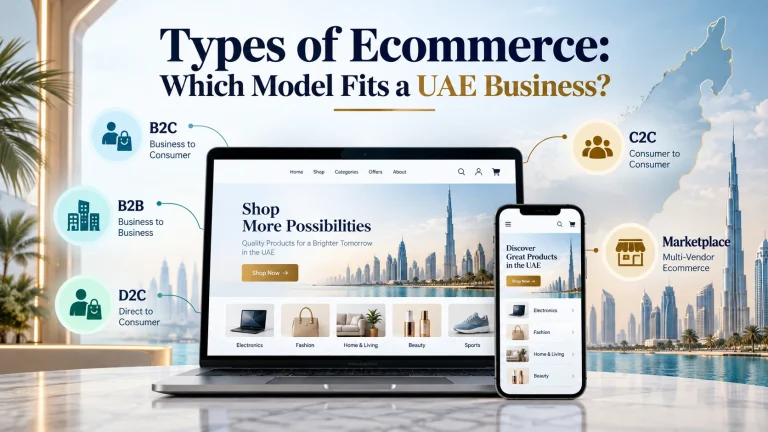
Business to Consumer, commonly called B2C, is one of the most familiar ecommerce models.
A company sells products or services directly to individual customers through an online store. Fashion, beauty, electronics, food, accessories, gifts, and home products commonly follow this model.
For example, a United Arab Emirates fashion retailer may let customers browse collections, select sizes, pay online, choose delivery options, and track orders.
B2C works best when the business wants to reach individual shoppers and manage the entire buying journey through its own ecommerce website.
The website should usually prioritise mobile usability, product discovery, clear product information, secure payment options, delivery details, and simple checkout.
2. Business to Business Ecommerce
B2B ecommerce connects one business with another.
Instead of selling one or two products to an individual shopper, a B2B company may handle larger orders, repeat purchases, negotiated pricing, account approvals, or quotation requests.
A United Arab Emirates supplier selling equipment to hotels is a simple example. The website may need customer-specific pricing, bulk quantity options, business accounts, invoice support, and repeat order features.
B2B ecommerce can suit manufacturers, distributors, wholesalers, office suppliers, hospitality suppliers, construction businesses, and other companies serving organisations rather than individual consumers.
A standard retail store structure may not be enough for this model. Website planning should reflect the actual purchasing process followed by business customers.
3. Direct to Consumer Ecommerce
Direct to Consumer, often called D2C, allows a brand to sell directly to customers instead of depending entirely on distributors, retailers, or marketplaces.
Suppose a United Arab Emirates skincare company develops its own products. Instead of selling only through large retailers, it can create its own e-commerce website and communicate directly with customers.
This gives the brand greater control over product presentation, customer data, promotions, content, and the overall shopping experience.
D2C can be especially useful for businesses building a recognisable brand rather than competing only on price.
The challenge is that the business also becomes responsible for attracting traffic, converting visitors, managing customer support, and coordinating fulfilment.
For this reason, D2C businesses need to think about ecommerce development and marketing together.
4. Consumer to Consumer Ecommerce
C2C ecommerce refers to online transactions where one individual offers products or services directly to another individual. Marketplace platforms are common examples. A platform may allow users to create listings while the website manages discovery, communication, payments, ratings, or other parts of the transaction.
For entrepreneurs, the opportunity is not necessarily selling the product themselves. The business opportunity may be creating the platform where buyers and sellers meet.
A United Arab Emirates focused marketplace could concentrate on used products, collectibles, fashion, specialist equipment, local products, or another specific community.
This model requires different technology from a normal online store because the website may need seller profiles, listing management, moderation, commissions, reviews, messaging, and marketplace payment processes.
5. Consumer to Business Ecommerce
C2B reverses the usual ecommerce relationship. Individuals provide products, services, content, or value to businesses.
Freelance platforms provide an easy example. A designer, photographer, creator, consultant, or influencer can offer services to companies looking for specific skills.
Creator marketing has also made this model increasingly visible. A content creator may produce promotional content for a brand and receive payment for the work.
For entrepreneurs planning a C2B platform, the website may need professional profiles, portfolios, project listings, quotation tools, payments, reviews, and communication features. This is very different from developing a conventional product store.
6. Marketplace Ecommerce
A marketplace allows multiple sellers to reach customers through one platform. The platform owner may earn through commissions, seller fees, advertising, subscriptions, or a combination of revenue sources.
Marketplace ecommerce can make sense when a business wants to organise fragmented sellers around a specific audience or product category.
However, building the website is only one part of the model. The business must also consider seller onboarding, product quality, payment distribution, customer complaints, returns, delivery responsibilities, ratings, and platform rules.
For United Arab Emirates entrepreneurs considering a marketplace, the key question is whether the platform solves a genuine problem for both buyers and sellers.
7. Subscription Ecommerce
Subscription ecommerce focuses on repeat payments rather than depending entirely on individual purchases.
Customers may pay weekly, monthly, annually, or according to another agreed schedule. Examples can include meal plans, coffee deliveries, beauty boxes, specialist products, digital services, memberships, or replenishment products.
The benefit is potentially more predictable recurring revenue. However, customers need a strong reason to continue paying.
A subscription ecommerce website may require recurring payment functionality, account management, delivery scheduling, subscription changes, cancellation options, and customer communication.
This model works best when customers need the product or service repeatedly rather than occasionally.
Which Ecommerce Model Fits Your UAE Business?
There is no single ecommerce model that is best for every company. A fashion or beauty brand selling to individual customers may fit B2C or D2C. A wholesaler serving United Arab Emirates companies may need B2B ecommerce. An entrepreneur connecting independent sellers with buyers may need a marketplace. A company selling something customers require regularly may consider subscriptions.
Some businesses can also combine models. A manufacturer may sell directly to consumers while also operating a separate wholesale section for business customers. A retailer may use its own ecommerce website while also selling through marketplaces.
The right decision should come from understanding the customer, order process, pricing structure, fulfilment requirements, and long term business plan.
Your Ecommerce Model Should Shape Your Website
Choosing an ecommerce model before development can prevent businesses from building a website that does not support their real operations.
A B2C store may need simple product discovery and fast checkout. A B2B website may need bulk ordering and quotation features. A marketplace needs seller management. Subscription ecommerce requires recurring payments.
Businesses planning an online store can review ecommerce website development in Dubai based on the selling model, customer journey, payment requirements, integrations, mobile experience, and future growth requirements.
The objective should not be to copy another ecommerce website. The website should support how the business actually plans to sell.
Choose the Model Before Choosing the Features
Ecommerce development often begins with questions about design, platforms, apps, and features.
The better starting point is the business model. Ask who will buy, who will sell, how often customers purchase, whether prices are fixed, whether sellers need individual accounts, how payments work, and how products reach customers.
These answers help determine the ecommerce structure. With United Arab Emirates online retail continuing to expand, businesses have opportunities across consumer retail, wholesale, marketplaces, direct brand selling, and recurring commerce. The strongest approach is not simply choosing the most popular model. It is choosing the model that matches how the business can create value for customers and operate efficiently.
If your business is planning to launch, improve, or scale a Shopify store in the UAE, MAQ Computer Services LLC can support you with Shopify store setup, customisation, integrations, performance improvements, and ongoing development based on your ecommerce requirements.
Frequently Asked Questions
1. What is the difference between B2C and D2C ecommerce?
B2C describes a business selling to consumers, while D2C specifically means a brand sells directly to customers without depending mainly on distributors or third-party retailers.
2. Which ecommerce model is easier to scale in the UAE?
Scalability depends on the product, target audience, fulfilment setup, technology, and marketing strategy. B2C, D2C, B2B, marketplaces, and subscription models can all scale when the operational structure supports growth.
3. Can a UAE ecommerce business sell to both consumers and companies?
Yes. A business can combine B2C and B2B models by offering standard retail purchasing for consumers and separate wholesale pricing, bulk ordering, or business accounts for companies.
4. Do ecommerce businesses in the UAE need different payment options for different models?
Often, yes. Consumer stores may focus on card payments and digital wallets, while B2B websites may also require invoices, quotations, purchase orders, or account-based payment arrangements.
5. Can an ecommerce business change its model later?
Yes. Businesses can expand from one model into another as they grow. For example, a D2C brand may later introduce wholesale B2B sales, subscriptions, or marketplace selling.