

Online shoppers often decide within a few moments whether an e-commerce website feels easy enough to continue using. A store may have good products, competitive prices, and active advertising, but customers can still leave when navigation feels confusing or the buying process requires too much effort.
A user-friendly e-commerce website helps customers move smoothly from discovering a product to understanding it and completing a purchase. For United Arab Emirates businesses, this matters because customers may arrive from Google, Instagram, Facebook, email, marketplaces, or paid advertising with different levels of purchase intent.
Improving usability is therefore not only a design decision. It can directly support product discovery, customer confidence, conversions, and repeat purchases.
Make Products Easy to Find
Customers should not have to understand the internal structure of a business before they can find a product. Clear categories, simple menus, useful search, and relevant filters help shoppers narrow their choices quickly. An online fashion store may allow customers to filter by product type, size, colour, price, or collection. An electronics store may need filters based on specifications, brands, or compatibility.
Search is also important when a store has a large catalogue. Customers who already know what they want may prefer searching instead of browsing through several categories. The easier it is to reach the right product, the fewer opportunities there are for customers to leave the website before making a decision.
Product Pages Should Answer Buying Questions
A product page should provide enough information for a customer to decide whether the item is suitable. Clear product names, useful descriptions, accurate images, pricing, availability, size information, delivery details, and return information can reduce uncertainty. Customers should not need to contact the business for basic information that could have been presented directly on the page.
Images should also help customers understand the product rather than simply decorate the website. Multiple views, product details, and clear presentation can make online shopping feel more reliable. A strong product page gives customers confidence to move towards the cart instead of returning to search results.
Build Trust Throughout the Shopping Journey
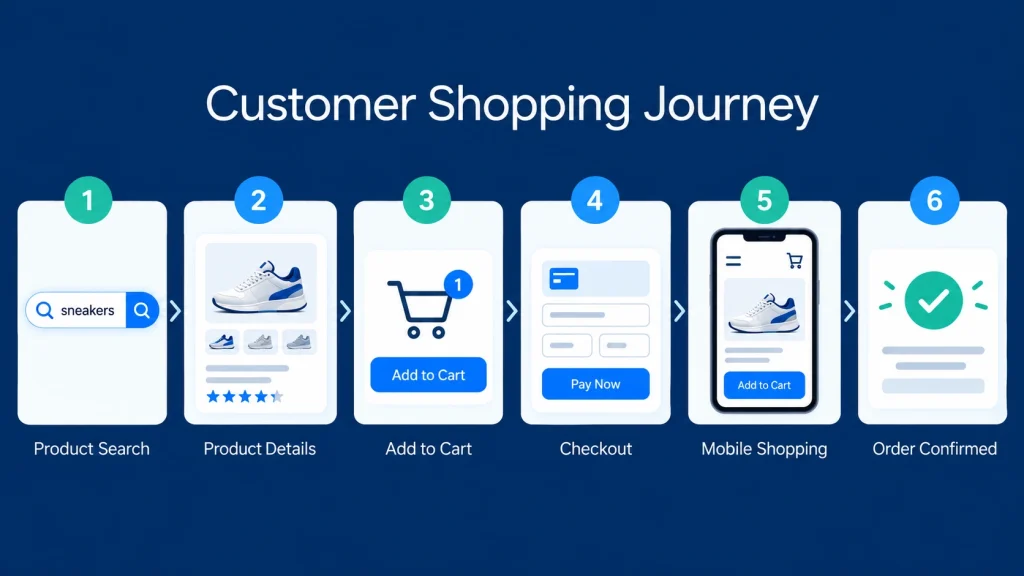
Customers are more comfortable buying when they understand who they are purchasing from and what will happen after payment. Contact information, delivery information, return policies, payment details, customer service options, and secure website behaviour all contribute to trust.
Trust should not be limited to the footer or an ‘About’ page. Useful information should appear at the stages where customers need it. For example, delivery expectations can appear on product pages, while payment and return information can be visible near the cart or checkout. This reduces uncertainty at important decision points.
Keep the Cart Simple
The cart should help customers review their purchase without creating unnecessary distractions. Product names, quantities, prices, discounts, delivery information, and the total amount should be easy to understand. Customers should also be able to change quantities or remove items without restarting the shopping process.
Unexpected information at this stage can create hesitation. If delivery charges or other conditions appear only after several checkout steps, some customers may reconsider the purchase. Clarity before checkout can make the transition from shopping to payment feel more predictable.
Reduce Friction During Checkout
Checkout is one of the most important parts of an e-commerce website because customers have already shown strong purchase intent. Businesses should avoid asking for information that is not necessary to process the order. Forms should be clear, errors should be easy to correct, and customers should understand what they need to do next.
Payment methods should also suit the audience and business model. The objective is to remove avoidable barriers between the cart and completed purchase. Businesses planning a new store or improving an existing one can review MAQ ecommerce development services to consider design, product structure, checkout, integrations, and wider ecommerce requirements together.
Mobile Shopping Must Feel Natural
Many customers discover products through mobile search, social media, messaging apps, and digital advertising. A store that is comfortable on desktop but difficult on a smartphone can lose customers before they reach checkout.
Text should be readable, buttons should be easy to tap, images should fit smaller screens, menus should remain simple, and forms should not require difficult zooming or scrolling.
Mobile usability should be considered from the beginning rather than treated as a smaller version of the desktop website.
Businesses can also review MAQ web design services when improving responsive layouts, navigation, user experience, and conversion paths.
Website Speed Supports Better Shopping
Customers expect e-commerce pages to respond quickly. Large images, unnecessary scripts, complex applications, and poorly optimised themes can slow the experience. Delays become particularly noticeable when customers move between category pages, product pages, the cart, and checkout.
Speed improvements should focus on the complete shopping journey rather than only the homepage. A faster experience allows customers to compare products, view information, and complete actions with less interruption.
Give Customers Clear Next Steps
Every important e-commerce page should make the next action understandable. A product page may guide the customer to add an item to the cart. A cart may guide them to checkout. A completed order may guide them towards tracking information or further support.
Calls to action should be visible without overwhelming the page. Too many competing buttons can make customers unsure about what they should do. Good e-commerce design helps the customer make decisions instead of making the customer study the website.
Use Data to Find Shopping Problems
Businesses should not rely only on personal opinions when deciding whether an e-commerce website is user-friendly.
Analytics can reveal where customers leave, which pages receive traffic, how customers move through the store, and where important actions decrease.
If many people view products but few add items to the cart, the problem may be connected to product information, pricing, trust, or presentation. If customers add products but do not begin checkout, the cart experience may require further review.
Website improvement works best when design decisions are connected with actual customer behaviour.
How MAQ Helps UAE Ecommerce Businesses
MAQ Computer Services LLC supports United Arab Emirates businesses with e-commerce development, Shopify solutions, web design, integrations, and digital systems designed around customer and business requirements.
An e-commerce improvement project may involve reviewing navigation, product pages, responsive design, checkout flow, platform functionality, integrations, website performance, and customer journeys.
Businesses using Shopify can also explore MAQ Shopify development services when they need store setup, design changes, customisation, integrations, or additional e-commerce functionality.
The goal is to create an online store that is easy for customers to use while also supporting the operational requirements behind the business.
Make Shopping Easier Before Trying to Increase Traffic
Increasing website traffic does not automatically increase ecommerce revenue. When the shopping experience is difficult, additional traffic may simply create more visitors who leave without purchasing. Businesses should first make sure customers can discover products, understand the offer, trust the store, and complete checkout comfortably.
A user-friendly e-commerce website makes each stage easier. When customers spend less time figuring out how the website works, they can spend more time deciding what they want to buy.
For businesses in the United Arab Emirates, improving that experience can create more value from existing traffic and provide a stronger foundation for future e-commerce growth.
Frequently Asked Questions
What makes an ecommerce website user friendly?
A user-friendly e-commerce website has clear navigation, useful product information, readable pages, simple forms, responsive design, understandable calls to action, and an easy checkout process.
How often should an ecommerce website be reviewed?
Businesses should review important customer journeys regularly and after major website, theme, payment, catalogue, or checkout changes.
Can too many product choices reduce ecommerce sales?
Yes. Large selections can become difficult to browse when categories and filters are unclear. Good organisation helps customers narrow their options.
Should customers be required to create an account before purchasing?
The right approach depends on the business. If account creation adds unnecessary effort, businesses should consider whether customers can complete the important purchase steps more easily.
Can a better ecommerce experience improve repeat purchases?
Yes. Customers are more likely to return when they can find products, complete purchases, and receive the information they need without unnecessary difficulty.


