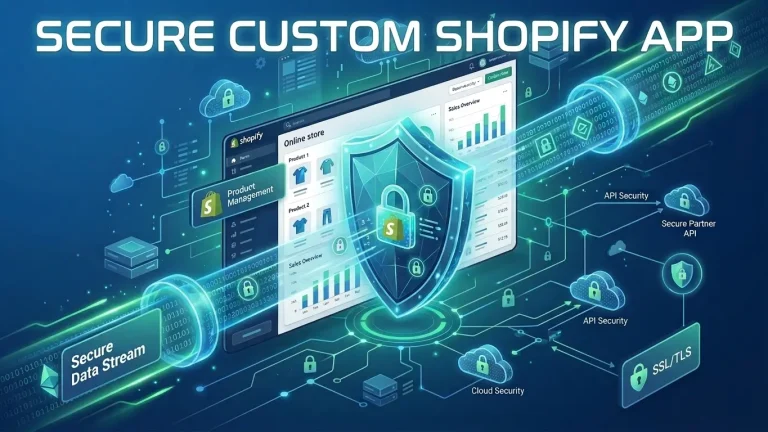
Are you confident that your custom Shopify app has the right security layers to protect your customers and your brand? Running an e-commerce business in the UAE means handling sensitive customer data every day — and that responsibility is not to be taken lightly. As cyber threats continue to evolve, businesses are increasingly asking how to ensure security in custom Shopify app development to safeguard their apps.
In this guide, MAQ Computer Services LLC explores how businesses can build secure and scalable Shopify apps. Learning how to ensure security in custom Shopify app development is essential for companies that want to protect customer data, maintain trust, and comply with modern data protection standards. Whether you are building a custom Shopify app or improving an existing one, implementing the right security practices helps safeguard both your business and your customers.
Why Shopify App Security Matters for UAE Businesses
The UAE has rapidly emerged as a global hub for digital commerce, with e-commerce revenues projected to grow significantly in the coming years. This growth is driving an increasing number of cybercriminals targeting online retailers and their customers. A security breach in your Shopify app can expose payment data. It can also erode trust and trigger regulatory fines.
Shopify data protection standards provide a strong foundation, but businesses must go further when building custom apps. Developers introduce new vulnerabilities if they do not adopt a security-first mindset. For UAE-based merchants, this is especially important given the country’s growing regulatory focus on data privacy and digital commerce compliance.
The consequences of poor security go beyond financial losses. Customers who feel their information has been mishandled are unlikely to return, and negative reputations spread quickly in competitive markets. Investing in robust security in custom Shopify app development is, simply put, an investment in your business’s long-term health.
Common Security Risks in Custom Shopify Apps
Before exploring solutions, it is important to understand the threats that businesses face. Many common vulnerabilities in custom Shopify apps stem from poor coding practices, insufficient authentication, or overlooked third-party integrations. Here are:
1. Insecure API Connections
Custom Shopify apps frequently communicate with external services via APIs. If API keys are hardcoded in source code or transmitted unencrypted, attackers can intercept and exploit them. Protecting API credentials and enforcing strict access controls are fundamental to maintaining secure access to customer data on Shopify.
2. Injection Attacks
SQL injection and cross-site scripting (XSS) are common threats to web applications. Therefore, custom apps that handle user inputs poorly are at higher risk. As a result, hackers may access or manipulate your database.
3. Weak Authentication
Apps that rely on simple passwords or skip multi-factor authentication (MFA) are significantly more expose to unauthorised access. Strong authentication mechanisms are non-negotiable for any app handling sensitive customer information.
4. Outdated Dependencies
Custom apps often rely on third-party libraries and packages. If these dependencies are not regularly updated, hackers can exploit known vulnerabilities within dependencies if developers do not update them regularly. Regular audits and timely updates are essential parts of a responsible customer data security policy.
How to Ensure Security in Custom Shopify App Development: Best Practices
Building a secure Shopify app requires deliberate planning from the ground up. The following best practices are consistently applied by experienced Shopify developers to protect businesses and their customers.
1. Follow Shopify’s Official API and Security Guidelines
Shopify provides detailed guidelines for app developers, including rules around OAuth 2.0 authentication, webhook verification, and HTTPS enforcement. Adhering to these standards is the starting point for every secure custom Shopify app. Developers who follow these guidelines reduce the risk of introducing vulnerabilities that hackers actively seek out.
2. Implement Strong Authentication and Access Controls
Every custom app should use Shopify’s built-in OAuth system for authentication. Moreover, enforcing role-based access control (RBAC) ensures that only authorised users can access sensitive data. This is especially important for apps managing orders, payment details, or customer profiles.
3. Encrypt Data in Transit and at Rest
All data flowing between your app and Shopify’s servers — or between the app and your customers — must be encrypted using TLS/SSL protocols. Similarly, sensitive data stored in your app’s database should be encrypted at rest. This is a core component of any serious customer data protection strategy.
4. Handle All User Inputs Securely
Every field that accepts user input is a potential entry point for injection attacks. Developers should validate and handle all inputs rigorously to prevent malicious code from being injected into your app’s queries or scripts. This practice alone eliminates a significant proportion of common web application vulnerabilities.
5. Conduct Regular Security Audits and Penetration Testing
Security is not a one-time activity. Scheduling periodic audits and penetration testing helps identify vulnerabilities before attackers do. Regular security reviews should be part of the ongoing development process to ensure your custom Shopify app remains secure as new threats continue to evolve.
6. Keep Dependencies and Third-Party Packages Updated
Set up automated alerts for updates to any libraries or packages your app relies on. When a security patch is released for a dependency, apply it promptly. A disciplined update process is one of the simplest yet most effective tools for maintaining the security of Shopify customer data.
7. Implement Logging and Monitoring
Real-time monitoring of your app’s activity allows you to detect suspicious behaviour early. Set up logging for failed login attempts, unusual API calls, and unexpected data access patterns. Early detection can mean the difference between a contained incident and a full-scale data breach.
Customer Data Protection: What UAE Businesses Need to Know
Protecting customer information is both a technical responsibility and a legal one. Businesses operating in the UAE must be aware of local and international frameworks governing the collection, storage, and use of customer data.
1. UAE Data Protection Law
The UAE has enacted Federal Decree-Law No. 45 of 2021 on Personal Data Protection, which establishes clear requirements for how organisations handle personal data. Businesses building custom Shopify apps must ensure their applications comply with these rules, including obtaining proper consent before collecting data and providing customers with clear information about how their data is used.
2. GDPR Considerations
If your Shopify store serves customers in Europe or processes data originating from the EU, you must comply with the GDPR. Shopify itself is GDPR-compliant, but your custom apps must be developed to reflect the same standards, particularly around data minimisation, consent management, and the right to erasure.
3. Building a Customer Data Protection Policy
Every UAE business running a custom Shopify app should have a written customer data security policy that outlines how the company collects data, who accesses it, how it protects it, and how it responds to breaches. Making this policy accessible to customers builds trust and demonstrates that your business takes data privacy seriously.
Shopify Policy and Platform-Level Protections
Beyond what developers build into custom apps, Shopify itself provides several platform-level security measures that merchants benefit from automatically. Understanding these protections helps businesses make informed decisions about where to focus their additional security efforts.
Shopify is PCI DSS Level 1 certified, which is the highest standard for payment card data security. This means that payment information processed through Shopify’s native checkout is handled with enterprise-grade security. However, if your custom Shopify app redirects payment processing outside of Shopify’s default flow, you must ensure that your alternative solution meets the same standards.
Shopify also provides automatic SSL certificates, regular platform updates, and fraud analysis tools. These features support your custom app’s security measures but cannot replace them. Shopify policy guidelines for app developers reinforce this distinction, making it clear that app developers share responsibility for the security of their products.
Choosing the Right Development Partner for Secure Shopify App Development
For UAE business owners who are not developers themselves, choosing the right Shopify development partner is one of the most critical security decisions they will make. A skilled and reputable partner will treat security as a fundamental part of the development process, not an afterthought.
When evaluating potential partners, look for teams that have demonstrated experience with Shopify’s API security requirements, a clear process for code reviews and testing, and familiarity with UAE compliance requirements. Shopify experts at MAQ Computer Services LLC bring this combination of technical knowledge and regional expertise, helping businesses across the UAE build apps that are both powerful and secure.
Conclusion
Security is not a feature you add at the end of a development project — it is the foundation upon which trustworthy e-commerce businesses are built. From implementing robust authentication and encryption to complying with UAE data protection laws and Shopify’s own developer policies, every layer of security you add protects your customers and your reputation.
As the UAE’s digital commerce landscape continues to grow, businesses that prioritise customer data security will earn long-term loyalty and a competitive advantage. Whether you are building your first custom Shopify app or reviewing the security of an existing one, the practices outlined in this guide provide a practical roadmap for getting it right.
Ready to ensure security in your custom Shopify app development and build a platform your customers can trust?
Partner with MAQ Computer Services LLC — UAE’s trusted Shopify experts — and let us help you develop a secure, scalable, and compliant Shopify app that protects your customers and powers your business growth.
| Contact M A Q Computer Services LLC Official Shopify Partner — UAE Phone: +971 55 494 3599 | +971 50 708 0116 Email: info@maquae.com Visit the official website: MAQ Computer Services LLC |
Frequently Asked Questions (FAQ)
1. Is my data safe with Shopify?
Shopify invests heavily in platform security and is PCI DSS Level 1 certified, demonstrating its commitment to the highest standards of payment data protection. The platform also uses SSL encryption and provides regular security updates. However, the safety of your data also depends on how your custom apps are built and configured — which is why working with experienced developers is essential.
2. Does Shopify comply with GDPR?
Yes, Shopify itself is GDPR-compliant and provides tools to help merchants manage consent, data access requests, and data deletion. However, if you use custom apps or third-party integrations, you must ensure those components are also built and operated in line with GDPR requirements. This is particularly relevant for UAE merchants serving European customers.
3. Will Shopify refund me if I get scammed?
Shopify typically does not provide refunds for transactions in which a merchant or customer has been scammed through fraud or a compromised app. In such cases, disputes are generally handled through the payment processor or the customer’s bank. The best protection against scams is to implement strong security practices and use verified, trusted apps.
4. How secure is Shopify from hackers?
Shopify’s core platform is built with robust security and is maintained by a dedicated security team. That said, the most common vulnerabilities arise not from the platform itself, but from custom apps, third-party integrations, and weak account credentials. Businesses can significantly reduce their exposure to hacking by following security best practices, using strong authentication, and regularly auditing their apps.