
Key Takeaways
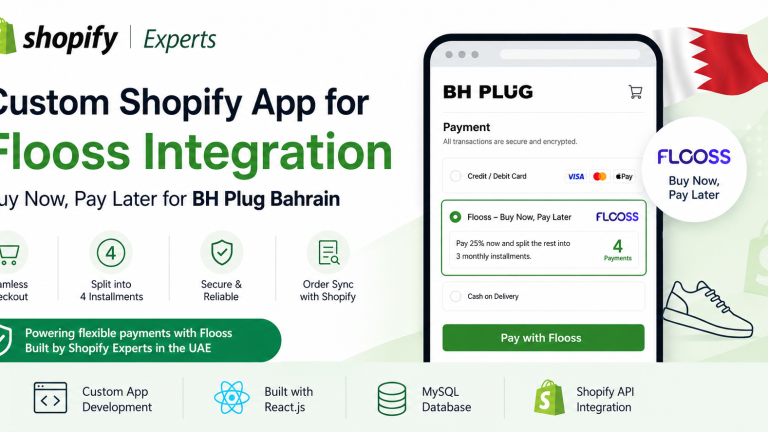
- BH Plug needed a Shopify app for Flooss integration, but no ready-made solution was available for its Shopify store.
- Flooss is a Bahrain-based Buy Now, Pay Later service that lets customers split purchases into 4 installments.
- MAQ Computer Services LLC built a custom Shopify app development using React.js, Shopify APIs, checkout extension logic, draft order handling, and a MySQL-backed database.
- The full project took around 3 to 4 weeks for development, followed by 1 week of testing.
- This project is a practical example of Shopify app development when a merchant needs functionality that Shopify does not provide natively.
What Is Shopify App Development?
Shopify app development is the process of building custom features for a Shopify store. It is useful when Shopify’s native settings or existing apps cannot handle a specific requirement.
Custom Shopify apps can include private apps, payment flows, third-party API integrations, checkout extensions, admin dashboards, and automation tools. These solutions are usually built around a merchant’s exact business process.
For many Shopify merchants, standard apps are enough. However, some business requirements are too specific for public apps or simple theme customizations. In such cases, a custom Shopify app becomes the better solution.
One recent example was the Shopify app for Flooss integration we developed for BH Plug Bahrain, a Bahrain-based Shopify store originally built by our team a few years ago.
The Client: BH Plug Bahrain
BH Plug is a Bahrain e-commerce store selling footwear, clothing, and lifestyle products. The store operates on Shopify and serves customers in Bahrain with products from well-known brands.
The client contacted us with a specific payment-related requirement. They wanted to offer Flooss as a payment option in their Shopify store so customers could complete purchases using a local Buy Now, Pay Later service.
The challenge was simple to describe, but technically complex to build: Flooss did not have a ready-made Shopify app. The client was not looking for a partial workaround. They wanted a full-fledged solution where customers could choose Flooss, complete the payment process, and have the order handled properly inside the Shopify ecosystem.
What Is Flooss?
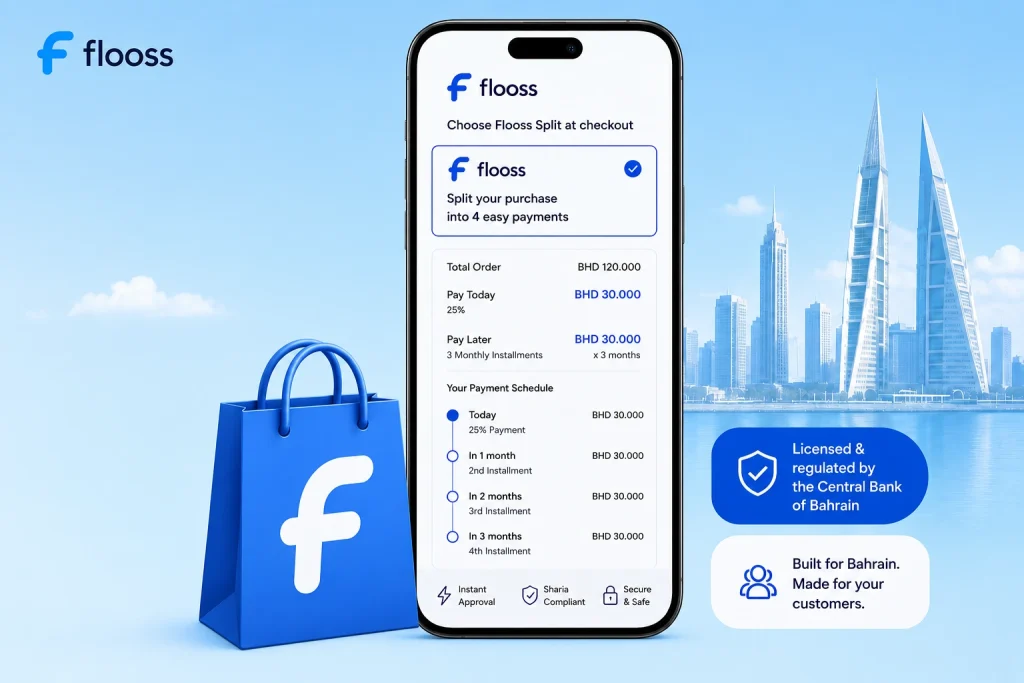
Flooss is a Bahrain-based financial service provider offering instant and Sharia-compliant financing solutions. One of its services, Flooss Split, works as a Buy Now, Pay Later option where eligible customers can split purchases into 4 monthly installments.
According to Flooss, customers can pay 25% upfront and leave the remaining amount for later installments. Flooss also states that it is licensed and regulated by the Central Bank of Bahrain.
For Bahrain merchants, this kind of local payment option can be important because it matches how customers prefer to shop. Instead of forcing customers to use only card payments or cash on delivery, merchants can provide a flexible installment-based checkout experience.
The Problem: No Ready-Made Flooss Shopify App
When BH Plug approached us, the main issue was that Flooss did not have a plug-and-play Shopify app available for merchants.
That meant there was no simple installation process like:
- Install the app from the Shopify App Store.
- Connect the Flooss merchant account.
- Enable the payment method.
- Start accepting payments.
Instead, MAQ had to study the Flooss APIs and documentation to understand how their payment flow worked and how it could be connected with Shopify.
After reviewing the technical requirements, we understood that the solution needed to be developed as a custom Shopify app with a Shopify checkout extension flow and supporting backend logic.
This is where proper Shopify API integration becomes important. A payment-related app cannot be treated like a normal frontend widget. It has to communicate correctly with Shopify, handle payment states, manage order creation logic, and support a clean user journey.
Our Solution: A Custom Shopify App for Flooss Integration
MAQ built a custom Shopify app for BH Plug that connected the Shopify store with Flooss and allowed customers to complete the payment journey using Flooss.
The goal was to keep the experience simple for both sides:
- Customers should be able to use Flooss without confusion.
- The merchant team should be able to manage the process without technical knowledge.
- The app should be responsive and easy to use.
- The payment and order flow should be reliable.
- Shopify and Flooss data should stay properly connected.
The app was developed using React.js for the interface. The backend was connected to a database hosted on a separate MySQL server. This helped store and manage the required transaction data, app-related records, and payment flow information.
Why We Used Shopify Checkout Extension and Draft Orders
For this project, MAQ explored multiple methods to create the smoothest possible user experience. The main approach involved Shopify checkout extension development because the requirement was closely connected to the checkout and payment experience. Checkout-related work in Shopify must be handled carefully, especially when building custom logic around payment options.
We also used draft order creation through the Shopify API in parts of the flow. This helped us improve the user experience and manage certain order scenarios more effectively.
Draft orders can be useful in custom payment journeys because they allow developers to create order-like records programmatically before final order completion. In a custom integration, this can help bridge the gap between a third-party payment approval process and Shopify’s order management system.
| System | Role in the Project |
| Shopify | Storefront, checkout, customer cart, and order management |
| Flooss | Buy Now, Pay Later payment approval and installment process |
| Custom App | API connector, transaction handler, user interface, and database logic |
| MySQL Database | Storage for app records and transaction-related data |
Development Timeline
The full development phase took around 3 to 4 weeks from start to finish. After that, we spent another week on testing. This testing phase was important because payment-related flows need more attention than normal website features. We had to check the customer journey, payment responses, order handling, edge cases, responsive layouts, and the admin-side usability of the custom app.
A typical Shopify theme task may be tested quickly, but a custom payment integration has more moving parts. The Flooss app needed to work reliably across the full flow, from customer action to Shopify order handling.
User Experience Was a Priority
One of the client’s main expectations was simplicity. We did not build the app only for developers or technical users. Instead, we designed it to be practical for normal store staff and non-technical users.
We kept the interface clean, responsive, and easy to understand. This mattered because a custom app is only successful when the merchant can use it comfortably after delivery. A confusing interface creates operational problems, even when the app is powerful. Our goal was to create an extended Shopify solution that feels natural for the business.
Why Custom Shopify Apps Matter
This Flooss project is a good example of why merchants sometimes need custom apps.
Shopify has a strong app ecosystem, but not every business requirement is available as a ready-made app. This is especially true when a merchant needs to connect with a local payment provider, regional logistics company, ERP system, wholesale workflow, CRM, or custom approval process.
Custom Shopify apps are useful when merchants need the following:
- A third-party API integration that does not exist in the Shopify App Store.
- A local payment or finance provider connected to Shopify.
- A private admin tool for staff.
- A custom checkout or order flow.
- Automation between Shopify and external software.
- A responsive app interface designed around their internal process.
For BH Plug, the requirement was clear: customers in Bahrain needed a Flooss payment option, and the merchant needed a complete Shopify-compatible solution.
Built by Experts in Shopify, Official Shopify Partners in the UAE
This custom Flooss Shopify app was developed by Experts in Shopify, the Shopify-focused service brand of MAQ Computer Services LLC. MAQ Computer Services LLC is listed in the official Shopify Partner Directory as a service partner based in Business Bay, United Arab Emirates. The company has been a Shopify Partner since January 2016.
This experience matters for custom app projects because Shopify payment flows, checkout extensions, API integrations, draft orders, database handling, and third-party service connections all require careful planning. A custom Shopify app is not just a frontend feature. It must work reliably with Shopify’s order logic, customer journey, merchant operations, and the third-party platform’s API rules.
For BH Plug, our role was to convert a business requirement into a working Shopify-compatible solution. Flooss did not have a ready-made Shopify app, so we built a custom app that allowed the store to support a Bahrain-based Buy Now, Pay Later payment experience.
As official Shopify partners in the UAE since 2016, MAQ Computer Services LLC has worked on Shopify store builds, migrations, theme customization, API integrations, custom apps, and ongoing Shopify development support for regional and international brands. If your Shopify store needs a custom payment integration, private app, checkout extension, or third-party API connection, visit our Shopify apps development service or learn more about MAQ Computer Services LLC.
Conclusion
The Flooss integration for BH Plug shows how Shopify app development can solve real e-commerce challenges when standard apps are not enough.
By combining React.js, Shopify API integration, checkout extension logic, draft order creation, MySQL database support, and responsive app design, MAQ Computer Services LLC created a custom solution that allowed BH Plug to offer Flooss as a Buy Now, Pay Later option for Bahrain customers.
An official Shopify Partner in the UAE, and has been part of the Shopify Partner ecosystem since January 2016. For merchants, this is the real value of working with experienced Shopify development partners: your store does not have to be limited by native features or existing apps.
If you need a custom Shopify app, payment integration, or API-based solution for your store, contact Experts in Shopify or explore our Shopify Apps service.
| Contact MAQ Computer Services LLC Official Shopify Partner — UAE Phone: +971 55 494 3599 | +971 50 708 0116 Email: info@maquae.com Visit the official website: MAQ Computer Services LLC |
Frequently Asked Questions
1. What is Shopify App Development?
Shopify App Development is the process of creating custom apps or extensions for Shopify stores. These apps can add new features, integrate third-party APIs, automate workflows, customize checkout experiences, or create private admin tools not available through Shopify’s default features.
2. Can Shopify integrate with local payment providers like Flooss?
Yes, Shopify can be integrated with local payment providers when the provider has APIs or technical documentation that support the required payment flow. If no ready-made Shopify app exists, the solution usually requires custom Shopify API integration and app development.
3. Why did BH Plug need a custom Flooss Shopify app?
BH Plug needed a custom Flooss Shopify app because Flooss did not have a ready-made Shopify app available. The store required a full payment flow where customers could use Flooss to pay, while the merchant could manage the process through a reliable Shopify-connected solution.
4. How long does custom Shopify app development take?
The timeline depends on the complexity of the app, APIs, checkout flow, and testing requirements. In the Flooss and BH Plug project, development took around 3 to 4 weeks, followed by 1 additional week of testing.
5. When should a merchant choose a custom Shopify app?
A merchant should choose a custom Shopify app when existing Shopify apps cannot solve the business requirement. Common cases include local payment integrations, ERP connections, custom checkout flows, private admin dashboards, automation tools, and third-party API integrations.


