Is your Shopify store operating at its full potential, or are disconnected systems quietly costing you time, money, and customers? How advanced Shopify API development can grow your business in the UAE is becoming a crucial factor for companies seeking operational efficiency and a competitive edge. In today’s competitive e-commerce landscape, Shopify API development is key to creating high-performing, connected online stores.
Shopify API development enables businesses to build custom endpoints, apps, and features tailored to their unique workflows. This technology streamlines inventory management, order processing, and customer engagement, transforming a standard Shopify store into a fully connected commerce engine. Businesses across retail, manufacturing, logistics, and services in the UAE are discovering that robust Shopify API capabilities are not just technical upgrades—they are strategic advantages.
In this comprehensive guide, MAQ Computer Services LLC explores how businesses can leverage Shopify API development to automate workflows, unify data, and accelerate growth.
What Is Shopify API Development?
Shopify API development is the process of creating custom APIs or connecting your Shopify store to external software applications, platforms, and services. APIs act as digital bridges, allowing two or more systems to communicate, exchange data, and trigger automated actions without any manual effort. When you implement API development, your store can interact directly with tools like accounting software, warehouse management systems, or marketing platforms, enabling seamless automation and real-time data synchronization.
How Shopify API Development Works
Shopify provides two primary API types that power most integrations and custom developments: the REST API and the more modern GraphQL API. Both APIs allow developers to read and write Shopify data — including products, orders, customers, and inventory — in real time. Choosing the right API type depends on the business use case: GraphQL is generally preferred for complex, performance-sensitive developments due to its efficiency in fetching only the required data.
Types of Shopify API Development
Shopify API development can serve a wide range of business functions. Most common types include:
- ERP Integrations – Streamline operations and synchronize business data.
- CRM Integrations – Centralize customer information and improve engagement.
- Payment Gateway Integrations – Enable seamless, secure transactions.
- Logistics and Fulfillment Connections – Automate shipping and inventory updates.
- Marketing Automation Links – Connect marketing tools for personalized campaigns.
Identifying which API development or integration category aligns with your business priorities is the critical first step toward a successful project. MAQ Computer Services LLC helps businesses map their existing technology landscape and identify the highest-priority API development opportunities, ensuring smooth implementation and maximum operational efficiency.
How Shopify API Development Helps Grow Your Business
The most direct impact of Shopify API development is that it allows your systems to communicate seamlessly, making your business faster, smarter, and more efficient. A skilled Shopify agency ensures custom APIs are built correctly, eliminating data silos, reducing manual work, and providing every department with access to accurate, real-time information. These improvements translate directly into faster order fulfillment, improved customer experiences, and stronger profit margins.
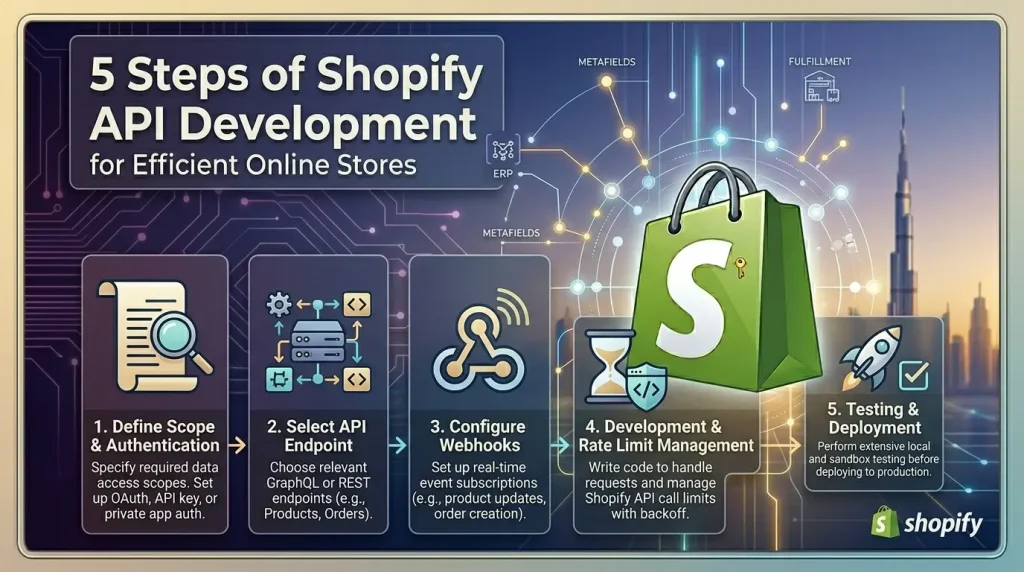
The 5 Real Steps of Shopify API Development
1. Define the Scope & Authentication
Start by determining whether you need a custom Shopify app for a single store or a public app for multiple stores. Next, set up proper authentication, either OAuth or API access tokens, in the Shopify admin so your application can communicate securely with the store. Proper authentication ensures your API can access necessary data while maintaining security.
2. Select the Right API Endpoint
Choose the API endpoint based on your business goal:
- GraphQL Admin API – Best for syncing orders, inventory, or ERP data.
- Storefront API – Ideal for building custom mobile apps or headless storefronts.
- Shopify Functions – Use this if you need to customize how discounts, pricing, or checkout behaviors work. Picking the correct endpoint ensures efficiency and reduces unnecessary API calls.
3. Configure Webhooks for Real-Time Data
Instead of constantly polling Shopify to check for new events, configure Webhooks to receive instant updates. Shopify can “push” data to your system whenever an event occurs, such as orders/create or products/update. This approach ensures your external systems always have up-to-date information with minimal delay.
4. Development & Rate Limit Management
Develop your integration by transforming Shopify data into a format your ERP, CRM, or other systems can understand. Implement rate limit management using techniques like the Leaky Bucket algorithm to avoid hitting Shopify’s API limits. This step ensures stable and reliable performance even during high-volume operations.
5. Testing & Deployment
Test the API integration in a development store using sample data to validate workflows and error handling. Once the setup works as expected, deploy the app to a live production environment, such as Heroku, AWS, or Google Cloud. Proper testing minimizes errors in live operations and ensures your business can rely on automated processes from day one.
The Benefits of Shopify API Development for Businesses
The commercial case for Shopify API development is compelling across every industry. Business owners consistently report significant improvements after implementing advanced Shopify API development with their stores.
1. Accurate, Real-Time Inventory Management
Overselling is one of the most damaging experiences a business can provide. By connecting your warehouse management system to Shopify through a custom app built with API development, stock levels are updated instantly whenever a purchase is made, a return is processed, or new inventory arrives. This real-time accuracy protects your brand reputation, reduces operational errors, and removes the customer service burden caused by failed order fulfillment.
2. Accelerated Order Fulfillment
Speed is critical in e-commerce, and a custom Shopify app built with API development can automate order routing to your logistics partners, significantly reducing the time between when an order is placed and when it is dispatched. Automated order routing, label generation, and carrier selection allow your team to spend less time coordinating and more time delivering. Businesses that implement these solutions often report a 40–60% reduction in order processing time.
3. Unified Customer Data
APIs developed for Shopify capture every customer interaction from first visit to repeat purchase in a single enriched profile. This unified view enables hyper-personalized marketing, smarter product recommendations, and proactive customer service that anticipates customer needs. The result is stronger loyalty and a measurable increase in lifetime value.
4. Streamlined Financial Reconciliation
Manual reconciliation between Shopify sales data and accounting records is time-consuming and error-prone. API development can connect your store to platforms like Xero, QuickBooks, or NetSuite, ensuring every transaction, refund, and tax calculation is automatically recorded and categorised. Finance teams save hours each week, and audits become significantly easier and less stressful.
5. Competitive Differentiation
Businesses leveraging API development operate with a structural efficiency advantage over competitors relying on manual processes. Faster fulfillment, personalized communications, and accurate inventory visibility contribute to a customer experience that is difficult to replicate without custom API solutions. In competitive markets like the UAE, this operational differentiation can be decisive.
Applications of Shopify API Development
The practical applications of Shopify API development span virtually every function of a modern business. Knowing the most impactful use cases helps business owners prioritize their development roadmap and build a fully connected operational ecosystem.
1. ERP Integration: The Operational Backbone
ERP integration with Shopify is the cornerstone of operational efficiency for growing businesses. With custom Shopify API development, your store can connect to your enterprise resource planning system, enabling bidirectional data flow — orders trigger inventory deductions, purchasing workflows, financial postings, and fulfilment processes automatically. Selecting the best ERP for Shopify requires evaluating native connector availability, data mapping flexibility, and scalability.
Leading ERP platforms with proven Shopify compatibility include NetSuite (ideal for mid-market and enterprise), Microsoft Dynamics 365 (best for Microsoft-centric organisations), SAP Business One (suited to manufacturing and distribution), and Odoo (an open-source, cost-effective option). MAQ Computer Services LLC has delivered successful ERP-Shopify development projects across all these platforms, tailoring each solution to clients’ specific operational requirements.
2. CRM Integration: Deeper Customer Relationships
Connecting Shopify to your Customer Relationship Management (CRM) platform via custom APIs transforms raw transaction data into actionable customer intelligence. Platforms such as Salesforce, HubSpot, and Zoho CRM can receive real-time purchase events from Shopify, enabling automated segmentation, targeted campaigns, and timely follow-up sequences. Businesses leveraging Shopify API development for CRM integration consistently achieve higher email open rates, better retargeting conversions, and reduced customer churn.
3. Marketing Automation Integration
Custom APIs connecting Shopify to platforms like Klaviyo, Mailchimp, or ActiveCampaign enable sophisticated behavioural marketing at scale. Abandoned cart sequences, post-purchase upsell flows, and VIP loyalty triggers can all be automated based on real-time Shopify events. Shopify API development brings enterprise-level marketing automation capabilities to businesses of all sizes, allowing highly personalized campaigns with minimal manual effort.
4. Logistics & Fulfillment Integration
Connecting Shopify to third-party logistics (3PL) providers, courier APIs, and warehouse management systems reduces manual effort in order dispatch. Shopify API development ensures tracking numbers are automatically updated in Shopify and shared with customers, returns are processed seamlessly, and fulfilment capacity can be dynamically allocated across multiple warehouses. For businesses selling internationally, multi-carrier API solutions ensure the most cost-effective shipping option is selected for every order.
5. Payment Gateway & Financial Integration
Beyond Shopify Payments, many businesses require connections to regional payment gateways, buy-now-pay-later providers, or B2B invoicing systems. Shopify API development enables these connections, ensuring that every preferred payment method is available at checkout. At the same time, financial integrations automatically reconcile transactions in your accounting platform, maintaining clean books without manual intervention.
Technical Challenges of Shopify API Development
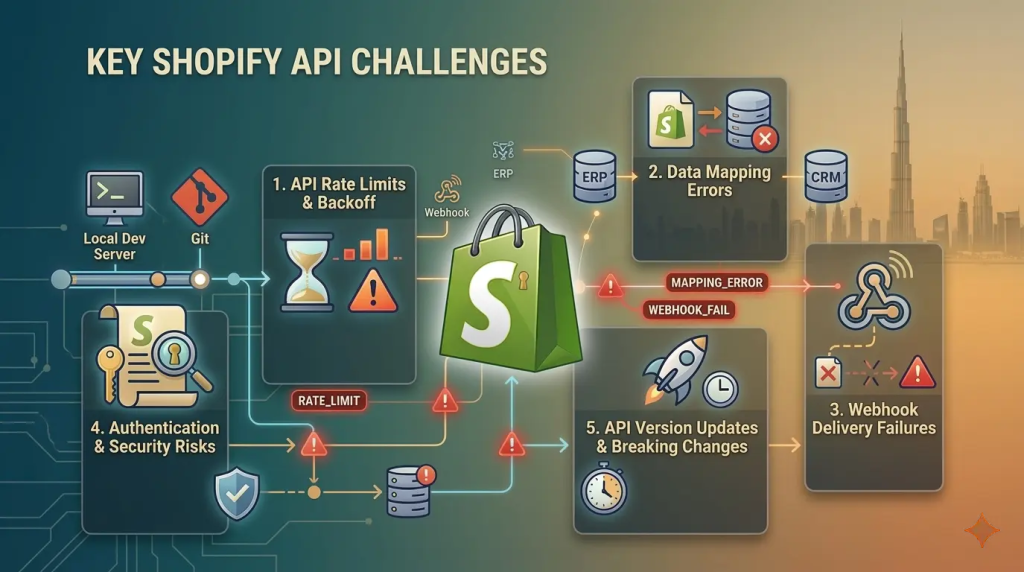
While the benefits of Shopify API development are substantial, business owners should approach projects with a clear understanding of the technical complexities involved. Awareness of common challenges enables better planning, realistic timelines, and ultimately more successful outcomes.
1. API Rate Limiting
Shopify enforces API rate limits to maintain platform stability. By default, REST API calls are capped at 40 requests per second, while GraphQL uses a bucket-based cost system. High-volume operations, such as bulk product synchronization or large-scale order imports, must be designed to respect these limits using queuing mechanisms and exponential backoff strategies. Failing to account for rate limits is one of the most common causes of performance issues in Shopify API development.
2. Data Mapping and Schema Differences
Every system structures data differently — for example, a ‘product’ in Shopify may correspond to multiple records in your ERP, and field names rarely align perfectly. Thorough data mapping before development is essential to ensure information flows accurately and completely between platforms. Overlooked mapping gaps often result in data quality issues post-launch, making upfront planning critical for long-term success.
3. Webhook Reliability and Error Handling
Shopify uses webhooks to push real-time events to integrated systems, but webhooks can fail due to network issues, system downtime, or processing errors. Robust Shopify API development incorporates retry logic, dead-letter queues, and monitoring alerts to ensure that no events are lost and every failure is addressed promptly. Without these safeguards, even a brief system outage can result in unprocessed orders or inaccurate inventory counts.
4. Authentication and Security
Managing OAuth tokens, API keys, and access scopes is critical for secure Shopify API connections. Excessive API permissions increase security risk, while insufficient permissions can break integrations. Businesses must also ensure that data transmitted between Shopify and connected systems is encrypted and that credentials are securely stored using industry-standard secret management practices.
5. Maintaining Integrations Over Time
Shopify regularly updates its API, deprecating older endpoints and introducing new features. A connection that works today may require updates as Shopify enforces its annual API version deprecation cycle. Partnering with an experienced Shopify developer, such as MAQ Computer Services LLC ensures your integrations are proactively maintained, minimising downtime and preventing technical debt from accumulating.
How Shopify with API Development Supports Businesses
The custom Shopify API allows businesses to connect their online stores to other systems, from ERPs and CRMs to logistics and payment platforms, creating a seamless, automated workflow. When built thoughtfully, these integrations not only reduce manual work but also improve accuracy, efficiency, and overall operational performance.
Approach to API Development
- Discovery & Planning: Understanding your current systems and business goals to design a solution that truly meets your needs.Data Mapping & Architecture: Defining how information will move between Shopify and other platforms before any development begins.
- Development & Testing: Building the integration step by step, testing thoroughly to ensure reliability before going live.
- Launch Support: Monitoring the system closely during the rollout to address any issues immediately.
- Ongoing Updates: Maintaining the integration over time to keep it compatible with Shopify updates and evolving business requirements.
Regional Expertise & Localization (GCC/UAE Focus)
For businesses operating in Dubai and across the GCC, Shopify with API development often requires a regional focus to ensure smooth operations and compliance. Key considerations include:
- Local Payment Gateways: Build custom integrations for regional providers such as PayTabs, Telr, or Network International, enabling seamless and secure transactions for local customers.
- Compliance & VAT: Use APIs to automatically generate invoices that meet UAE Federal Tax Authority (FTA) requirements, including displaying the Tax Registration Number (TRN).
- Last-Mile Delivery: Connect Shopify to local couriers like Aramex, ensuring proper handling of regional address formats and automated SMS notifications for customers.
Proper localization ensures that your Shopify store operates efficiently, meets regional regulations, and delivers a superior customer experience in the UAE and GCC markets.
Conclusion
Shopify API development can significantly improve how a business operates. By connecting your store to the tools that support your operations — whether ERP, CRM, logistics, or marketing platforms — you can save time, reduce errors, and deliver better experiences to your customers.
Well-designed APIs help businesses stay competitive by streamlining workflows, improving inventory accuracy, and providing actionable insights. In the UAE and GCC markets, strategic API development ensures compliance, optimizes regional logistics, and sets the foundation for future growth.
Ready to Unlock the Potential of Shopify with API Development?
MAQ Computer Services LLC helps businesses explore how advanced Shopify API development can grow your business in the UAE. A well-designed API strategy enables automation, improves decision-making, and accelerates order fulfilment, creating a more efficient, reliable, and profitable online store.
| Contact MAQ Computer Services LLC Official Shopify Partner — UAE Phone: +971 55 494 3599 | +971 50 708 0116 Email: info@maquae.com Visit the official website: MAQ Computer Services LLC |
Frequently Asked Questions
1. Is the Shopify API free?
Shopify APIs are included with your Shopify plan, though some features may require a Shopify Partner account or paid apps. Having access to the API allows businesses to automate workflows and connect external systems without relying on manual processes.
2. What programming language is used for the Shopify API?
Shopify APIs can be accessed using any language that supports HTTP requests, such as JavaScript, Python, PHP, or Ruby. Both GraphQL and REST endpoints are language-agnostic, making it flexible for developers to work with their preferred technology stack.
3. Do I need a Shopify Partner account?
A Shopify Partner account is required for app development, private app credentials, and testing API integrations. This account also provides access to development stores and tools to safely build and test custom APIs before going live.
4. Can Shopify API development work with ERP or CRM systems?
Yes. Custom APIs enable full integration with ERPs, CRMs, marketing tools, logistics systems, and payment gateways, providing a unified operational workflow. Integrating these systems ensures real-time data accuracy, improves efficiency, and delivers a smoother customer experience.